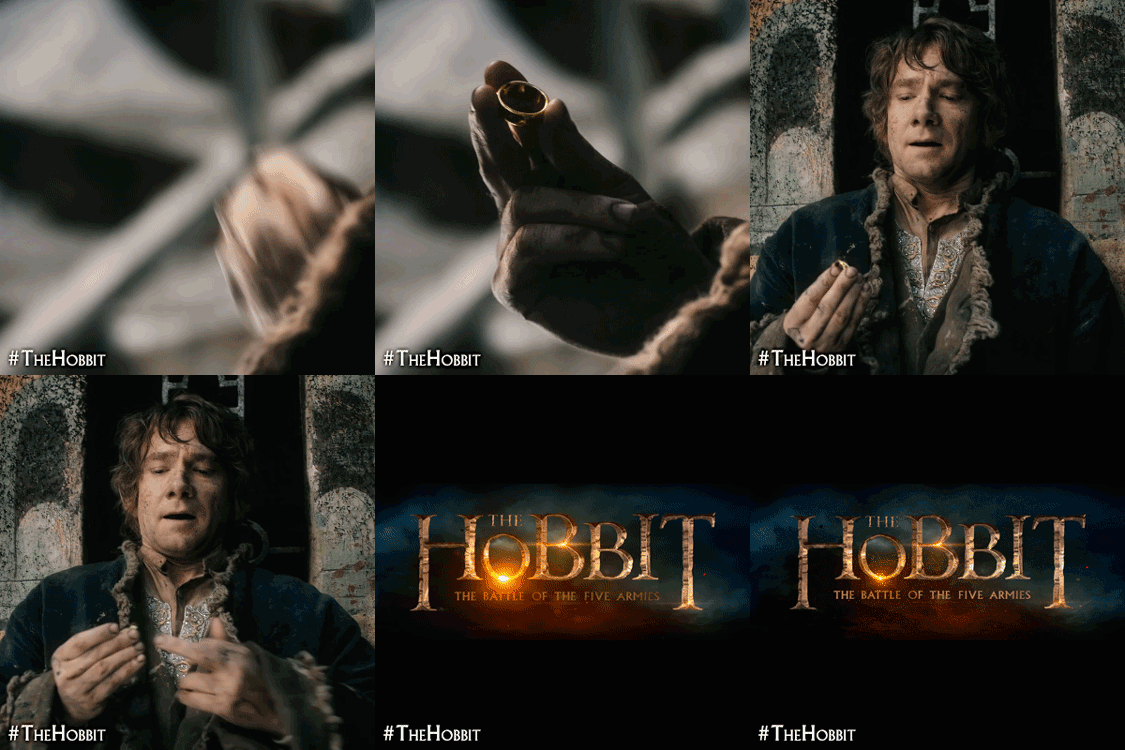
Now that I've gotten all that nostalgia off of my chest...
I have to be straight with you, when we got out of the theater and everyone in my party was gushing over the movie and saying, "I can't think of anything they did wrong."
I was thinking, "Welll...I can think of like five things." But I didn't say anything cuz that would be a JERK thing to do...
Just like those guys in the back of the theater who were bashing Legolas and talking about how stupid the dwarves were RIGHT BEFORE THE FRIKIN' MOVIE!
------------------
If you haven't seen the movie, this post will probably not make any sense to you. And even if you have seen it, there's no guarantee that my command of the english language will be decipherable.
But just in case: Be advised, this post contains spoilers for The Hobbit: Battle of the Five Armies.
This post is the third and last in a series exploring why the movies in The Hobbit Franchise Stink.
Here is part one (I also explain what it means for a movie to stink in this post, it's not always a bad thing)
I'd been waiting for this scene ever since I found out they were expanding The Hobbit's plot beyond Bilbo's POV. Gandalf tells Bilbo about how he and the rest of the White Council stormed the Necromancer's lair and drove him out of Mirkwood. A bunch of magic people casting out a dark sourceror sounds preety cool, it's even cooler when the Necromancer is actually a disguised Sauron and the "Magic People" are all your favorite mentor-characters from LOTR
IT FINALLY HAPPENS!!! and it did not disappoint. In LOTR, you feel like you're seeing them waining, here you get to see them fight in their hay-day.
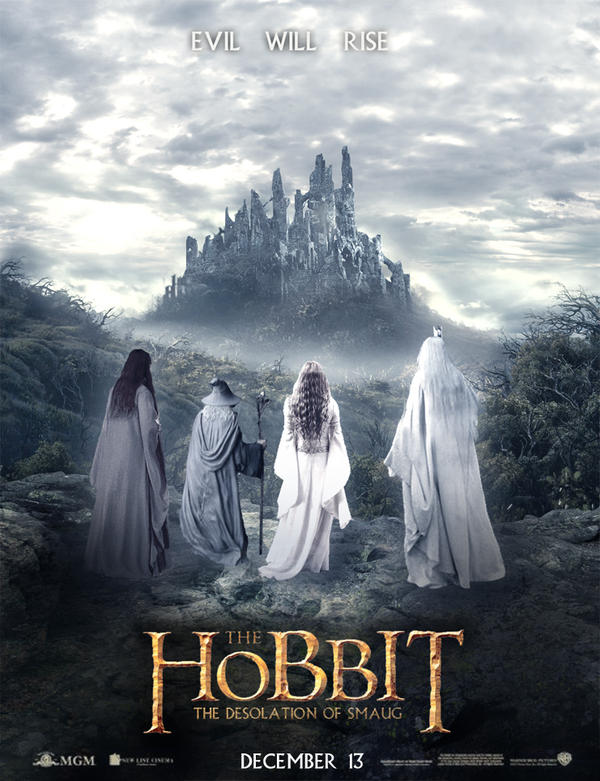
(they should do this more often)
My only gripe is: the scene was over pretty fast. :(
Thranduil
This one is mixed for me. Thranduil in the movies is a very different type of person than he is in the book. Its as if they took a guy with the exact same tragic back story and had him deal with that trauma in a completely different way.
Thranduil is a seriously damaged dude.
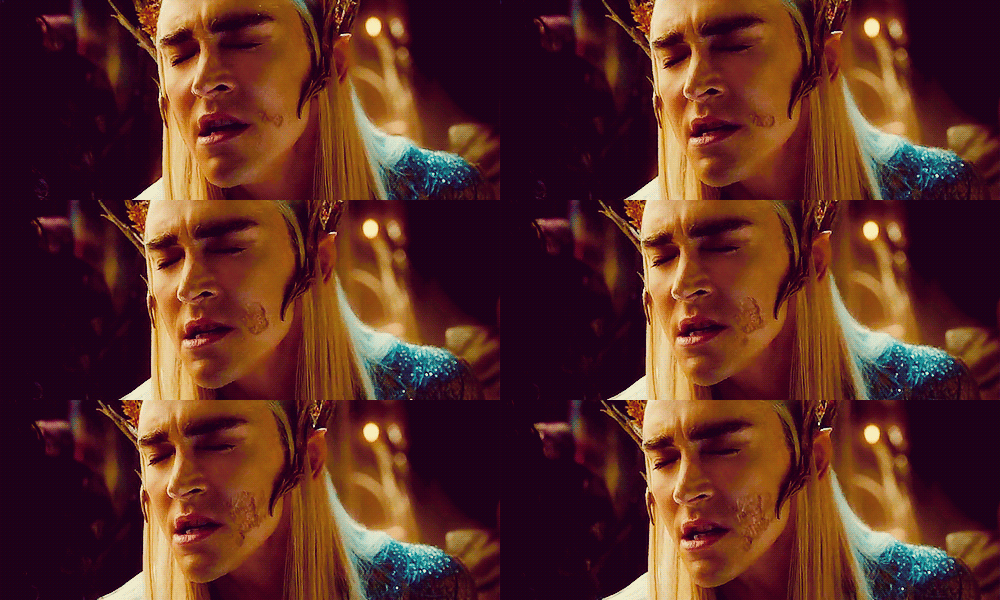
(And not just cuz of his face)
I was watching waiting for the moment when this character was going to get confronted with the magnitude of the destruction that's going on around him. (and kinda go "hey, maybe I should not be such a jerkface") A moment moves him to pity his destitute human neighbors, or recognize/regret his role in magnifying a political dispute.
That moment did not happen
(Don't even get your hopes up for a Thorin/Thranduil reconciliation...not going to happen...)
Thranduil has so many examples of good behavior around him. Bard, Bilbo, Gandalf, Tauriel, Legolas and he takes absolutely none of them to heart. I won't say he's heartless, but he might be the most cold-hearted primary character in these movies.When helps the people of Laketown, but makes it clear he's only doing this so he can get his monies. He has this moment during the battle where he stops and looks around at the loss of life around him, but wherase in the book takes into the account the loss of all life (goblins, dwarves, humans, elves) Thranduil is ONLY looking at his own people. He has this great opportunity to tell his son that he loves him and he chooses not to. And the reconciliation arc between himself and Tauriel is very self-referential. He's talking about her heartbreak, but he's really talking about his own. In general, Thranduil is beyond empathy for anything that doesn't affect him personally. AND HE DOESN'T CHANGE.
Usually, this is the type of thing I would find completely irritating in a story, but in this case it made sense. Thranduil is (in a sense) dead on the inside. In a story that deals with issues like grief and loss, it's meaningful to have a character who is so irremediably damaged by them.
(On a side note: I really would have loved to see Thranduil finally getting his hands on those diamonds. I really would have loved to know if it was worth it to him.)
Thorin
I was very close to putting this on the list of thinks that stink, but I think that (despite some inconsistencies and one pretty cheesy moment) it was meaningful.
In the movie, the gold sickness pretty much ONLY effects Thorin. And the manner in which it affects him resembles an episode of psychosis: complete with paranoia and hallucinations.
The thing I don't like about this alteration is that it robs the story of a moral complexity. If you'd like to read more about moral complexity in The Hobbit, I'd like to suggest this post: In Defense of Bilbo Baggins
For Book!Thorin confronting the reality of a five-sided battle is what made him re-evalute his priories.
(It's one thing to think, "OMGosh I hate those guys I wish they would all just die." and then sitting there, watching it happen.)
Movie!Thorin overcomes Gold Sickness by confronting his own feelings of guilt and inadequacy...by himself...in one scene.
It sounds cheesy, and I thought it was at first too...
But in Tolkien's world, people become heroes by embracing humility, and the journey Thorin goes on in this version of the story embraces that morality.
Even though he's a king and he's prideful and he's gained all of this wealth and power
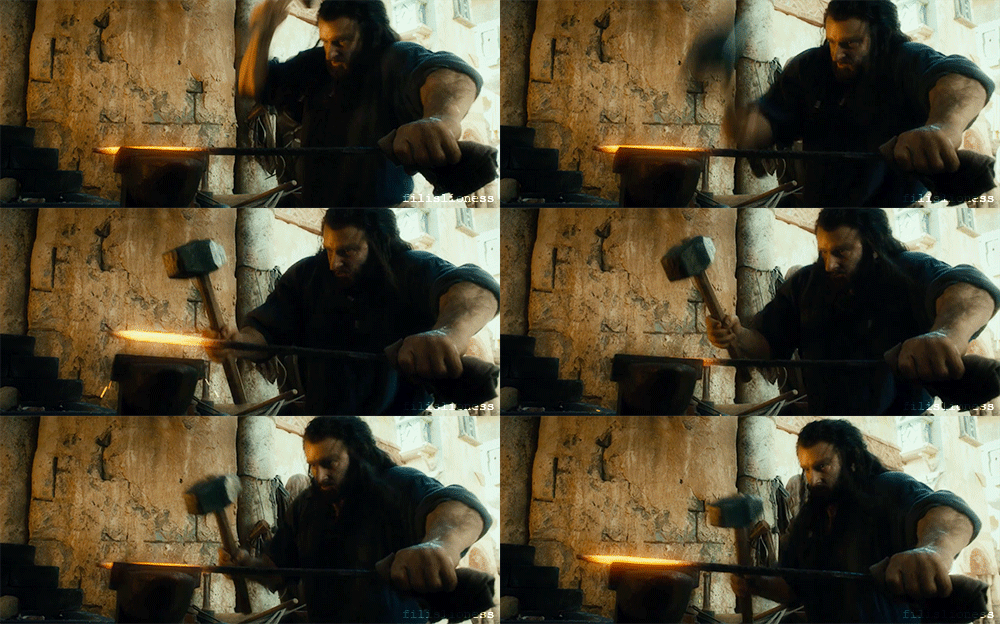
He still sees himself as the guy who was reduced
to fixing other people's stuff for a living.
It's clear that Thorin's "pride" at the beginning of the movie is corrupt. It doesn't stem from self-confidence; it exists to cover up some really, really severe self-esteem issues.
I think the most compelling personal journey in the series is when Thorin chooses to drop that facade. Thorin chooses a humility and, unlike the hobbit main characters in the story, it does not come naturally to him. But ultimately, it's a choice of self-acceptance and self-affirmation.
There is a saying I read that goes: "True pride and true humility are exactly the same thing."
Subconsciously I think I've always realized this, but in recent years I've come to know that it's not a concept that a lot of people understand. For that reason, I'm very glad it was included in this movie.
It was over in like five minutes, but it was a super intense five
minutes...not like they were trying to get it over with. The fact
that they were able to reinforce a father/child trust relationship in
the midst of all that was amazing.
Romantic Subplot
People who are not fond of this romance will hate this movie. The story-arc pretty much follows their most negative expectations...
(It's a straight up love story. Not even a love triangle. Tauriel never loved Legolas I don't know why people kept thinking that she did, she seemed totally uncomfortable and weirded out when thranduil suggests it And Legolas discovers that his feelings for Tauriel because he identifies her with his mother.)
As a person who never hated the idea of romance in this story, I was not at all offended. In fact I thought it was really meaningful.
Remember that Hobbit Radio Drama from BBC I mentioned in my last post?
(No mormonhippie, I don't.)
The radio drama introduces Rivendell as a community of elves with mixed-race heritage and introduces the king of Rivendell "Elrond Half-elven".
Well, I automatically assumed that some of their ancestors were dwarves. So it wasn't hard for me to imagine a dwarf/elf relationship when I was first exposed to the story.
Nowhere in Tolkien's work is the possibility of such a union contradicted and the one time this elf chick's jealous elf-boyfriend says anything like "elves and mortals aren't supposed to get married except for, like, one or two times" (In The Children of Hurin)...Tolkien contradicts that by creating a whole other community of mortal half-elves (in Return of the King). This leads me to believe that inter-racial marriage in middle earth was fairly common, even though it probably wasn't talked about a whole lot.
So, as a response to the question, "Why did they need an elf/dwarf romance??"
In a story that's about the importance of compromise, reconciling differences, and appreciating the beauty in other people I say:
"WHY THE HECK NOT??!?!?!"
Can't think of anything that could present these themes in a better way than an inter-racial romance. And although it didn't quite turn out the way I thought it would, it emphasized a sense of the sense of permanent personal loss that was absent in other aspects of the story.
*On a side note:
Elrond, man...can you imagine what it would be like
to watch your TWIN brother grow old and die
while you stay young forever? #ugh #feels
I'm not saying these were improvements upon the book, because most of them are not. But I do understand why these alterations were made and I believe they were appropriate given the change from literary to cinematic format.
And Now...
The Things That Stink about "The Hobbit: Battle of the Five Armies"
Music
I really didn't notice any new themes when I watched he movie. I bought the soundtrack on CD to try and listen to it more closely...and the first CD sounds like relaxing background music. Kinda lame, especially when most of the movie is fight scenes and all they can play is 'LET'S ALL FREAKING FALL ASLEEP' music
I guess after 5 movies you run out of ideas.
Sad story: The second CD (the one with the credit's song that I really wanted to listen to) split in half before we could even take it out of the container.
/Cry.
Billy Boyd has a fantastic voice and the song that he sings during the credits is a lovely tribute to all the people who've spent their lives creating these movies.
Azog and Bolg, The Albino Goblins Who Magically Transformed Into Orcs...
They finally mention that these two guys are family (Legolas refers to Bolg as "the spawn of Azog" )
But that's about it. The Book!Hobbit provided this excellent template for exploring the fact that goblins and orcs are people (I mean...corrupt evil people but still) . I think it would have been cool if Bolg's motivation were seeking revenge for the death of his dad (like in the book). But that road was not taken, and I'm disappointed.
Bilbo
In terms of acting, I think this movie might be the first time I looked at the character and saw Bilbo and not Martin Freeman (and that was mostly due to his interaction's with Thorin). It's unfortunate that, as far as characterization, Bilbo never succeeds on his own merits.
Like I have mentioned before, I don't think this is the actor's fault. The writers gutted Bilbo's personality and either deleted or redistributed everything that made him a unique and engaging character to character's like Tauriel or Legolas.
His character arc began and finished in the first film, and quality of this series has suffered for it.
The Battle
I'm not going to go into detail on this one; I'm just going to say that Professor Tolkien wrote out a very involved, dynamic, and compelling battle scene... that I would have LOVED to see on screen...and the filmmakers pretty much scrapped it. Also, it really stinks that Wargs aren't represented as one of the five armies, I liked the idea that wargs are sentient and have their own government and everything, but no...in the movies they're just cool looking horses. One thing I did like was that Bilbo was a bit more involved and didn't get knocked out until the end.
Pacing (I'm not talking about people walking back and forth, or that actor who plays Thranduil)
An adverse effect of stretching one small book into three big movies is that you have to fill the movies with fluff. (I wouldn't mind the fluff if they included the parts of the story with substance as well; unfortunately they don't)
But there is another problem as well-
Do you remember this moment?
(The Bilbo/Thorin hug?)
It's sweet
And awkward.
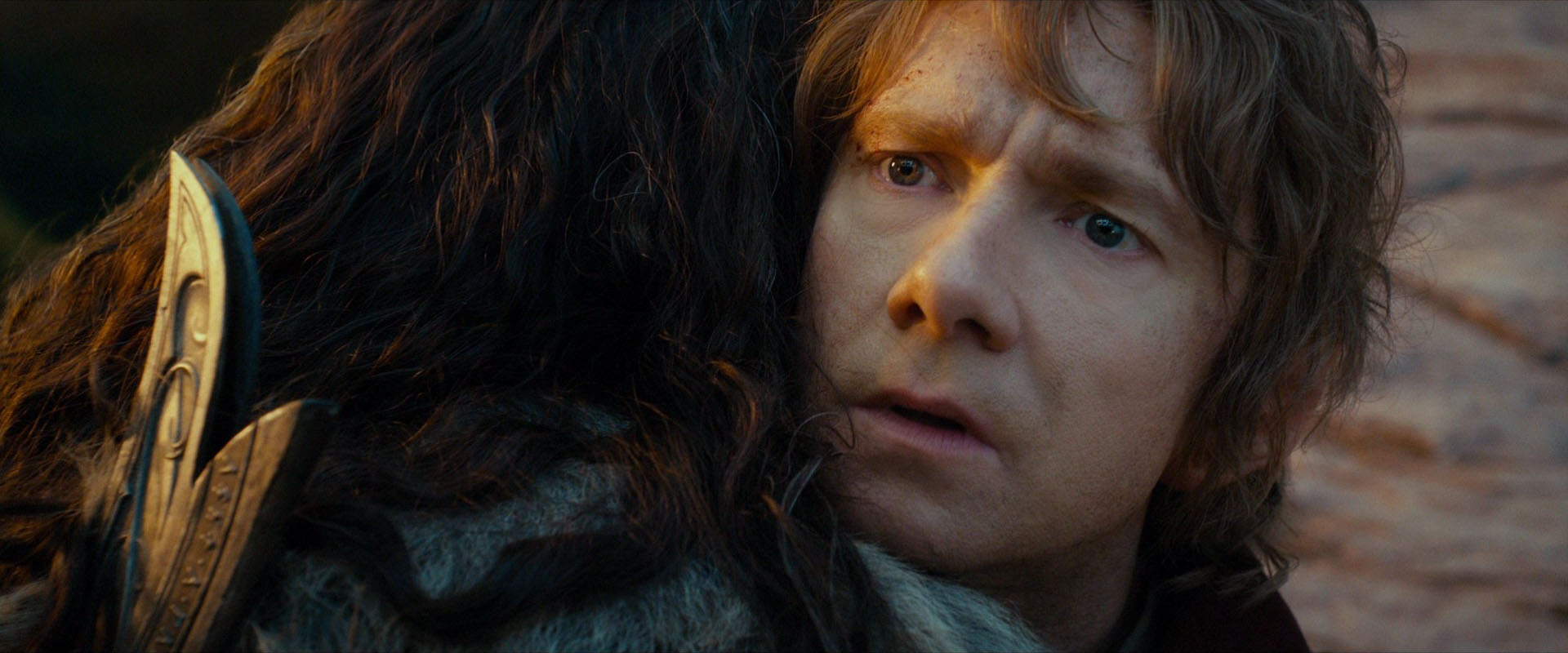
And says a lot about their relationship.
In the book, there is no single definite moment in which Bilbo "wins" Thorin's affection and friendship. Bilbo and Thorin don't emotionally get to the "Hug" stage until the final act.
It's sweet
Because Bilbo has been hungering for acceptance and respect since day #1. He's no longer the dorky little brother who needs protecting, Thorin makes it clear that he's respected and valued as an equal.
It's awkward
Because Bilbo is contemplating treachery. He's just spend this whole book building these relationships with these people and he's about to give it all up.
It's gut-wrenching and ultimately tragic and it did not translate well to the movie because they built the Thorin/Bilbo relationship in one scene two movies ago.
Alfrid Wormtongue (I don't care if that's not his real last name)
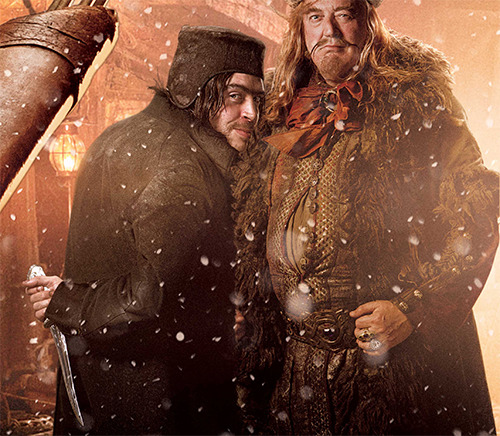
This character started out pretty interesting. He's an a bit of an inept opportunist; he's not evil, but he's not particularly noble or good. He's morally ambigous and, at the start, it makes him a breath of fresh air.
Until his thirdfourth FIFTH vignette...Then you're just hoping he dies as soon as possible.
Good vs. Evil
This aspect of the story wouldn't have been so bad IF THE HOBBIT WERE IN FACT A STORY ABOUT GOOD and EVIL...
I'm very embarrassed that some fairly intelligent people (Like Peter Jackson, the three movie reviewers I read today, and millions of movie-viewers all over the world) think that this story is about good and evil
Guys....
The Lord of The Rings is a story about Good vs. Evil...
The Hobbit is a story about Right vs. Wrong
That may seem nitpicky, but it's an important distinction. None of the characters are confronting evil, they are confronting each other (and themselves).
Conclusion:
This movie would have been absolutely wonderful if it weren't for the book. The book, according to new line cinema, is a pesky juvenile fairytale novella that just isn't worthy of the big screen...that is...until Peter Jackson came along and fixed it.
To be fair, Peter Jackson didn't want to do the job; and I have the feeling that, instead of resigning himself to it as an obligation...as something that he had to do...
he owned it... (a little too much so)
Like, 'If I'm going to do this job, I'm going to do it my way.'
I can't say I resent him for pressing his advantage, especially when he's sacrificed so much of his life and health for something that he apparently didn't want to do in the first place.
I am a bit pissed at people who look down on The Hobbit because it's a more of a fairy tale that just happens to exist in a world of high fantasy. This is not an opinion that was created by the hobbit-movies, but I am seeing it expressed more as people are exploring the source material for the hobbit movies and finding something lacking.
(If you have a general distaste for fairy tales...and I mean, like, Grim-Brothers stuff...the old folk-tales type stuff but hold High Fantasy in regard....PHLEESE DO NOT READ THE HOBBIT!!!
I would also recommend that you refrain from reading The Smith of Wootton Major, Leaf by Niggle or any of JRR Tolkien's works outside of The Lord of the Rings.
These stories will NOT live up to your expectations, PLEASE DON'T READ THEM....
also you suck)
It wouldn't be so bad if these movies weren't called "The Hobbit: [Insert Subtitle Here]" That title suggests the story is actually about one particular character having all these things happen to him.... and that's NOT what these movies are about.
I used to think it would be cool if they made a movie called "Thorin and Company" (because it sounds cool) and it would emphasize this colorful group of people and the different roles each member had (with emphasis on the burglar, of course). That would be epic... (I need to make a poster) But that's not even what this movie did. A lot of people like to pretend that Peter Jackson was using Tolkien's unfinished tales/history of middle earth to "fluff" the hobbit story with a history of middle earth (like Thorin's backstory, Thranduil's people, and Azog's background etc.)
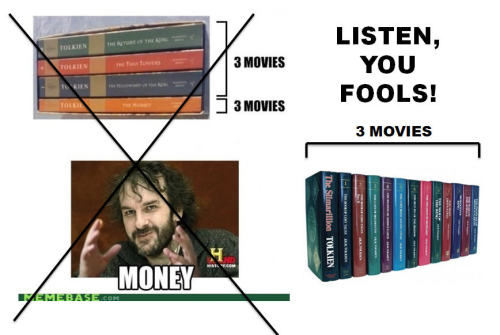
(by people who like to fool themselves into thinking that The Hobbit films honor Tolkien's vision of middle earth) if that's the case, he did a pretty bad job at that because those storylines were misrepresented as well.
So what does this movie NOT suck at? It's good fanfiction. I don't mean this in a disrespectful way (not all fanfiction is bad) but it's less of an adaption than it is a re-creation. I can accept it as an affectionate nod to Tolkien (or rather the Lord of the Rings movies), but it does not necessarily honor the source material.
Yesterday I finished watching The Hobbit Trilogy in theater. And as much I'd love to tell you how much it sucks, I'm too caught up on nostalgia of the past 14+ years of my life.
So, that's what I'm going to talk aboutfirst.
If you don't want to a review my adolescent/Tolkien #feels please skip this post. I'll upload the content/thematic review shortly (either tomorrow or, you know, whenever I feel like it)
Annyyway....
When I was about 13-14, my sister Red got a dramatized edition of The Hobbit on five white cassette tapes with grainy, 1968-era audio sound (That, judging from the reviews on the product, pretty much everyone except me hates)
The story/script was compelling. Right from the beginning, there are these vivid descriptions that lead into the story without weighing the story down.
The cast was fantastic; The Narrator, the bumbling/stuttering Bilbo Baggins ("B-A-double-G-I-N-S"), Thorin, Gandalf and Gollum. Later, when I started Fellowship of the Ring and decided I should read the book version of The Hobbit, those voices were the ones I imagined.
Movie-goers fell in love with Richard Armitage's voice as he sang the adventure-anthem "Far Over The Misty Mountains" for the movie. (and for good reason, it's an excellent rendition). In the same way, fell in love the version of that song in the radio drama. It's longer, the tone is different but to me it's every even more enchanting because its the song that first ushered me into the adventure.
(I loved this song so much, I wrote more verses to it....mostly about what the people in Dale were doing when the dragon attacked and about what the dwarves were planning on doing. They weren't very good, but you know...fanfiction.)
I don't recall if I was babysitting or at school, but for some reason Red was able to listen to the story ahead of where we had left off. She left me in Gollum's Cave, she was at the Battle of Five Armies. When I opened the door to the room, she was listening to the last cassette tape...
"NO!! You can't come in!!"
...and she slammed her body against the door to keep me out.
"You have to listen to it all the way though!"
I typically don't mind being spoiled when it comes to plot points, but I am so glad my sister did this for me.
I went in to listening to the story no knowing what was going to happen. She wasn't being mean or anything, we both were enjoying the story and I knew if she didn't want me to skip chapters, it was because what was coming next was really, really good. And that just skipping to the end would make me enjoy it less.
She was totally right. The last 1/3 of the story blew me away.
One of the reasons I think the story resonated with me is because of what was happening in my life at the time.
If I recall correctly we started the story just prior to, or concurrently with, me beginning community college courses and volunteering at the hospital (and, in general, preparing for the future that I wanted to have: as a nurse, as a young adult, and ultimately as a wife/parent).
Bilbo's beginning could have easily been written as a midlife crisis (If it was, he would be looking back at his life with regret and book!Bilbo doesn't do this.) but Tolkien didn't do that. Even though Bilbo is an older man when the story begins, this story is his coming of age. It's the part of his life in which he's deciding who he wants to be.
A Few of Bilbo's "Teen" Struggles:
He worries about what other people think about him
He's wants to be dependable and worthy of trust
He lacks practical experience.
He struggles with fitting in.
He gets depressed and overwhelmed (and kinda gothy)
He gets obnoxious and cocky
He (sometimes) gets lonely, even when he's surrounded by a bunch of people.
He's competent
He's theanti hero
I think I can pretty much echo Movie!Gandalf when he says:
Sometimes when I was in school or at work I would quote Bilbo to myself. Not the really memorable/meaningful quotes, just the little snippets of Bilbo being Bilbo: When I was overwhelmed (Why oh why did I ever leave my hobbit hole), or pleased with myself (Now I am a burglar indeed.) or disappointed ([So this is victory...] It seems a very gloomy business).
It sound really pathetic, but it gave me a lot of encouragement because I idolized him (still do ;))
Even if no one had ever thought to turn Tolkien's books into movies, this story would still have had a affect on my life (but it's probably would have been something that I'd have kept in my heart...Not posted twenty blog posts about, or dressed up as Thorin Oakenshield when I go to the theater.)
Here are some of my favorite (meaningful) Quotes from The Hobbit:
“He fought the real battle in the tunnel alone, before he ever saw the vast danger that lay in wait.”
A sudden understanding, a pity mixed with horror, welled up in Bilbo's heart: a glimpse of endless unmarked days without light or hope of betterment, hard stone, cold fish, sneaking and whispering. All these thoughts passed in a flash of a second. he trembled. And then quite suddenly in another flash, as if lifted by a new strength and resolve, he leaped.
“Well, are you alive or are you dead?” asked Bilbo quite crossly. Perhaps he had forgotten that he had had at least one good meal more than the dwarves, and also the use of his arms and legs, not to speak of a greater allowance of air. “Are you still in prison, or are you free? If you want food, and if you want to go on with this silly adventure–it’s yours after all and not mine–you had better slap your arms and rub your legs and try and help me get the others out while there is a chance!”
“Then something Tookish woke up inside him, and he wished to go and see the great mountains, and hear the pine-trees and the waterfalls, and explore the caves, and wear a sword instead of a walking-stick.
“Go back?" he thought. "No good at all! Go sideways? Impossible! Go forward? Only thing to do! On we go!" So up he got, and trotted along with his little sword held in front of him and one hand feeling the wall, and his heart all of a patter and a pitter.”
“Surely you don’t disbelieve the prophecies, because you had a hand in bringing them about yourself? You don’t really suppose, do you, that all your adventures and escapes were managed by mere luck, just for your sole benefit? You are a very fine person, Mr. Baggins, and I am very fond of you; but you are only quite a little fellow in a wide world after all!”
“You! You!” cried Thorin, turning upon him and grasping him with both hands. “You miserable hobbit! You undersized—burglar!” he shouted at a loss for words, and he shook poor Bilbo like a rabbit.
“Thief, thief, thief! Baggins! We hates it, we hates it, we hates it forever!”
“You certainly usually find something, if you look, but it is not always quite the something you were after.”
“Gandalf, dwarves and Mr. Baggins! We are met together in the house of our friend and fellow conspirator, this most excellent and audacious hobbit—may the hair on his toes never fall out!”
"[I] have no use for adventures. Nasty, disturbing, and uncomfortable things! Make you late for dinner! I can't think what anybody sees in them." “Don't tell us about dreams – dream dinners aren't any good and we can't share them.”
“I may be a burglar...but I'm an honest one, I hope, more or less.”
“To the end of his days Bilbo could never remember how he found himself outside, without a hat, a walking stick or any money, or anything he usually took when he went out; leaving his second breakfast half-finished and quite unwashed-up, pushing his keys into Gandalf’s hands, and running as fast as his furry feet could carry him down the lane, past the great Mill, across The Water, and then on for a mile or more.”
Here is a link to a PDF that talks about resucitstion of a trama victim: http://www.google.com/url?sa=t&source=web&cd=9&ved=0CEoQFjAI&url=http%3A%2F%2Fwww2.warwick.ac.uk%2Ffac%2Fmed%2Fresearch%2Fhsri%2Femergencycare%2Fprehospitalcare%2Fjrcalcstakeholderwebsite%2Fguidelines%2Ftraumatic_cardiac_arrest_2006.pdf&ei=HplfU6elJoOayAS1u4LwBA&usg=AFQjCNF5Le8OaJfeAsWN4v2ktDkcYivKWQ
Different things have to be taken into account in a trauma victim then a CHF patient. You still analyze theit heart rhythm and defibrillate/start compressions but if they are actively bleeding you don't do it as long, esspecially not if they aren't showing signs of improvement.
I've heard several horror stories but, thankfully, I've never had to do CPR on someone with penetrating trauma.
Without adequate glucose suppy cells will not be able to carry out metabolism and will die. However, hypoglycemia is not always considered part of the "H's and T's"
One reson for this is that most of the body's cells (the heart included) will usually find an alternate method of metabolism (for instance glycogen, fat or protiens etc.) so even when you're not eating, you still have access to energy.
Another is that the heart will not be the first organ to fail when glucose is very low. The brain will because it cannot metabolize any other source of energy besides glucose.
A hypoglycemic person eventually will suffer from cardiac arrest, but first they'll feel tired, maybe a bit cranky (maybe have a seizure) and pass out (sometimes it looks like they just went to sleep, this is why the nurse will wake you up to check your blood sugar)
...AND THEN they'll stop breathing.
The most common condition to precipitate profound hypoglycemia is insulin overdose in a diabetic patient. This is why many hospitals have introduced protocol for two licensed nurses to verify the insulin type and dose before administration (and also why nurses can be very anal about making sure you eat after you take your insulin, they're just trying to keep you safe!).
I had a habit of checking the drug, dose, time and patient before giving insulin from nursing school so it was a bit of an adjustment not having that protocol at my first job. I got in the habit or doing that with the patient whenever possible. Sometimes they are too confused or it pisses them off, but I think it's really importiant to get it right.
If a nurse gives a fast acting insulin and the patient doesn't eat right away, the blood sugar will drop. If the nurse gives a longer acting insulin & a regular insulin the patient might have hypoglycemia in the early morning before breakfast. (depending on the level of functioning the pancreas has, remember if your type 2 diabetic your pancreas is still making some of it's own insulin and that has to be factored in to your insulin dose...but I'll save that for a later post.)
This is why the nurse pokes your finger so much.
Yes, I'm sorry I hate to do it :-(
Luckily there is an antidote for hypoglycemia. Because insulin is a naturally occuring hormone, it is counteracted by another naturally occuring hormone called glycogen...which is availible in commercial drug form as glucagon gel (squirted on the gums) or give intramuscularly. (It works pretty quickly!)
So even though its not part of the "H's and T's" its still a good idea to check a patient's blood sugar if you're concerned they are deteriorating, esspecially if they are diabetic and recieving insulin therapy.
Not long ago I worked in a SNF (Skilled Nursing Facility). It's the type of place people go when they are not sick enough to stay in the hospital and not well enough to live at home.
A part of my job there involved responding to laboratory reports recieved from the laboratory center via fax.
One day, after doing my first rounds and recieving report I checked the fax for these lab reports. I noticed a report for a particular patient in the stack of papers, it was for a BMP (Base Metabolic Panel, or Electrolyte Panel) and the results were listed as "Pending"
This is not a rare occurance. Sometimes if lab results aren't complete, it's nice to get a notice that they're still working on it, that they haven't been missed or forgotten.
Later on that evening I checked the fax machine again and there was another lab report for the same patient. The report still was marked "Pending".
It is a bit weird to have a rutiene lab take that long, esspecially when all the other labs that were collected at the exact same time as this one had already come back.
The patient was alert and verbally responsive throughout the evening, participating in self care and complaining of only chronic pain.
Early in the morning, the CNA providing care in the room saw the patient become unresponstive and stop breathing. A pulse could not be felt. We started CPR and called 911. The patient was taken to the hospital in cardiac arrest.
I spent a lot of the rest of the morning calling people and documenting what had happened.
The whole event was unanticipated and upsetting, esspecially when I heard the fax machine printing out another set of papers.
They were lab results for the patient who had just been sent out...
And they were still "Pending".
I later learned that the lab had reiceved the blood, and it had been processed, but the level of pottassium in the sample was so high that they did not accept it as an accurate reading. They called later in the day to say they were sending out another phlebotimist to collect another sample because the pottassium level was abnormally high.
Pottassium is a mineral like salt, when it desolves in water it becomes an ion refered to as K+ (or K) it is primarily an intracellular ion involved in many processes including glucose transportation accross the cellular membrane and muscle function.
Low levels of K (hypokalemia) can occur during diuretic therapy in "pottassium wasting diuretics".
Hypokalemia is also associated with certian endocrine disorders: in diabetic patients, high levels of glucose are also associated with low levels of pottassium. In Cushing's Syndrome (when the adrenal gland is releasing too much of the steroid hormones cortisol and ACTH) the cells are put into "energy storing mode". Which causes conversion of glucose to storable forms of energy such as glycogen or fat, this also lowers the pottassium level as the glucose must be transported inside a cell in order for it to take place.
High levels of pottassium (Hyperkalemia) occur when a patient with renal problems is recieving a special kind of diuretic called a "pottassium sparing diuretic" or alternatively is recieving a supplemental pottassium vitamin at too high a dose.
It is also associated with hypoglycemia in diabetes and in Addisons disease-when the adrenal gland is releasing too little of the steroid-hormone cortisol or ACTH, causing the cells to be in energy consumption mode-this condition leads to low glucose levels and (...you guessed it) hyperkalemia.
People with Addison's disease will need to take steroid replacement drugs long term, unfortunately long term steroid replacement is associated with
Cushing's Syndrome
:(
There is a very narrow therapeutic range for pottassium (3.5-5.0 mEq/L), so a patient with a blood pottassium level of 7 mEq/L has a critical value for that lab. People with critical values for pottassium are in extreme danger of suffering from life-threatening arrythmias.
Now, it is possible to get a false critical value. Sometimes if a blood sample sat out too long the blood cells lyse (break apart) and all the intracellular pottassium gets mixed up with the extracellular pottassium, making the overall reading to be higher. When this happens, another sample needs to be collected.
Hypokalemia causes the heart to repolarize very, very slowly. This means that the T wave (the beginning of repolarization) will be flat and there will be another wave between it and the P wave of the next PQRST complex. This new wave is called the 'U' wave. If the patient does not recieve supplemental K via pills or a diluted dose IV, Torsades de Pointes will develop (a particular type of V Tach)
Hyperkalemia causes the heart to take a long time depolarize, resulting in flat P waves, a wide QRS complex and peeked T waves. Eventually this will also deteriorate into V Tach and V Fib, if its not dialized.
Pottassium is an importiant lab to monitor. If you have a high or low reading (even if you think its false) its importiant to communicate it. I'm not even being dramatic when I say its a matter of life and death. The worst that would have happened in an innacurate lab draw is the patient got sent to the hospital and monitored closely until the pottassium level was verified.
This one is always hard for me to remember. Partly because it DOESN'T ACTUALLY START WITH AN H!!!! and also because I view it as a side effect, not a cause.
Acids are a waste product of metabolism. Particularly anabolic/anaerobic metabolism (which is the kind that occurs in the absense of oxygen...so as you can imagine, a patient recovering from cardiac or respiratory arrest will have a lot of acid in their body!)
In an anaerobic state, the cells are trying to keep working, even though they don't have oxygen to act as the catalyst for the metabolic pathway that results in energy. So, they make it out of other molecules...with hydrogen's left over as junk.
In high concentrations, hydrogen acitic damage the cells. (A fact which I've pretty much taken for granate for many years, as the focus of most educational material I've exposed myself to is on acidosis (the process of producing acid) and not acidemia (the acidotic state itself))
There are two main ways the body rids itself of these acidic molecules:
Lungs via Breathing (fast acting)
Kidneys via Diuresis (slower response)
Your body produces acid when you exercise or when your body is under stress (think of leg cramps or 'burning' muscles after running) but most of the time a healthy person can deal with this by breathing more heavily...and even though you might feel sore for a couple of days, eventually your kidneys rid your body of the rest of it and it's not a problem.
Acid production is normal, it only really becomes a problem if your kidneys or lungs are diseased. This is why I often think of acidosis as a side effect, not a cause. However, it is an independent factor to consider when dealing with a when dealing with a cardiac arrest scenario.
If the patient has been in respiratory distress, and/or is suffering from kidney failure. Acidotic condtions may persist even after optimal oxygenation has been re-established (or alternatively, kidney function has been re-established via diuretic/dialasis use) because the acid produced is still too much for the body to handle.
Most of the people I have seen who suffered from acidosis (or 'Hydrogen Ion Excess') were already very sick and experienced this condition secondary to the initial illness. It's importiant to monitor the acutely ill patient for this complication.
(Now that I think of it, I believe one individual who was suffering from alcohol overdose and malnutrition also had a form of acidosis. And people who are diabetic can suffer from ketoacidosis...hmm)
Labs that are vital to assess in a patient suffering from this type of problem are the Blood Gas Analysis. There are guidelines to help determine if the patient's acidotic/alkalotic condition is caused by respiratory failure or kidney failure depending on the ratio of the the kidney capacity indicator HCO3 and ventilation capcacity indicator PCO2, but I'll save that for the hypothetical respiratory therapy post because it's complicated and I don't feel like explaining it right now.
(Ketones, alcohol and lactic acid would probably be importiant too.)
The treatment for acidosis is dependant on the cause (if it is due to respiratory failure, the patient might need to be on a ventilator. If it is due to kidney failure, the patient might need dialysis.) The only emergency drug to treat acidosis is the base-Sodium Bicarbonate and it has been taken out of ACLS protocol and is only used under special cirumstances.
Hypoxia just means the tissues of the body are not getting enough oxygen to function.
Hypoxia can also occur peripherally due to factors such as anemia, CHF, PAD, emboli or CO poisoning. (but we won't talk about those right now) I'm pretty sure the type of hypoxia they are talking about involves ventilation and gas exchange at the lungs.
There are MANY causes of hypoxia, here are a few I could think of:
Enviornmental: Decrease in inspired oxygen not secondary to organ failure. For instance, suffication (blocked airway) or high altitude.
Hypoventilation: A decrease in inspired oxygen due to altered ventilation pattern. Narcotic OD, or neurologic damage to respiratory drive.
Airway Inflammation/Increased Resistance to Airflow: occurs in Asthma, Emphysema, Anaphlaxis, and Bronchitis.
Impared Gas Exchange at alevolar/capillary membrane-
Alveoli are blocked, collapsed or swollen: Pneumonia, Aspiration, Pneumothorax, Pulmonary Edema.
The alveolar membrane becomes thick: emphesemia, Acute Respiratory Distress Syndrome, and Pulmonary Fibrosis. This inhibits gas exchange from the alveoli to the capillary.
Look for signs and symptoms of respiratory distress...
Not breathing
ANY difficulty breathing...rapid, slow, shallow, deep, involving rib cage
Restlessness and anxiety (eventually progressing to lethargy and coma)
Pale/blue skin-esspecially fingers or lips
Pulse Ox reading low. (Usually below 91 in adults is abnormal, however patients with known lung disease like COPD may have "normal" baseline that is below that)
Cold skin
Elevated BP
Elevated HR (eventually progressing to bradycardia)
Arterial Blood Gas Analysis
If the patient happens to be on a ventilator, there are a whole different set of things to monitor that belong on a respiratory therapy post.
Hypothermia occurs when the body's core tissues become cold; usually 95 degrees F (35 degrees C) or colder.
(Core body tempuratures are usually measured in the rectum, esophagus, or bladder)
Low body tempuratures inhibit cellular metabolism, and cardiac arrest can result if optimal tempuratures are not restored.
Normally when I think of hypothermia, I think of exposure to extremely cold elements (like freezing water or snow) being the cause. But I live in the desert and the only times I've ever seen it is in people suffering from alcohol overdose. It is also a risk in people suffering from sepsis, when the thermo-regulation mechanism in the body has failed...or in the homeless population. In general, people who are ill, exposed, and cannot meet their own needs are at risk.
(Optimal body tempurature is usually 97.7-99.5 degrees F.)
There are four degrees of Hypothermia. Depending on the severity, the patient will need to undergo rewarming measures:
Mild: 90-95 degrees F. (Passive rewarming, remove cold or wet clothing and apply dry and warm covering. Allow patient's body provide it's own warmth)
Moderate: 90-82 degrees F. (Active external rewarming, forced air device over body or heat packs to underarms and groin...if you wanna be getto like that ;))
Severe: 82-68 degrees F. (Active internal rewarming, warm IV fluids I believe at a temp of 100.4 degrees F is recommended, but I'm not positive)
Profound: < 68 degrees F
I mentioned above that cardiac arrest can occur in hypothermia because cellular metabolism is inhibited. Because the cells have stopped working, any drugs you give the patient when the body tempurature is extremely low will not work. This is a concern because if a patient is extremely cold (below room temp) and is recieving CPR, the drugs given as part of ACLS protocol won't have any effect. (The defibrillation shock probably won't work either)
Partly because of this, a patient cannot be declared dead until the body has been warmed to at least room tempurature, and cellular metabolism has been given the chance to resume.
There is a treatment called therapeutic hypothermia in which the body tempurature is lowered to 91 degrees F.after a period of hypoxia or stress, your hospital will have specific protocol for when and how to use this treatment.
1) Absolute-meaning loss of blood or a blood component from the body
2) Relative-meaning pooling or compartmentalizing of blood or a blood component into one area of the body.
In absolute hypovolemia, blood volume has actually been expelled. The two most common causes are hemorrhage and diuresis.
When I think of hemorrhage, I usually think of laceration wound or car accident-blunt trauma, even blood loss that has been documented and monitored from surgery can cause problems if it is not replaced.
But I've also seen many cases of gastrointestional bleeding that caused hypovolemia. Sometimes people have these ulcerations along their digestive tract and even if they've been there for a long time they can become super-irritated and bleed. If it's in the stomach, and the blood loss is acute, the patient might vomit frank blood or curdled blood. If it is a slower, 'chronic bleed' it might pass through the GI tract and come out the other end so it's importiant to examine stool. If its from the stomach or early in the digestive tract, it will be partially digested. Digested blood isn't red, it's dark and tarry.
If the stool has reddish streaks or you see blood then the bleed occured later in the digestive tract.
Whole blood may be lost via hemmorrage, but loss of blood components can also cause hypovolemia. This is the case with diuresis.
Interstial fluid (the fluid component with electrolytes) is lost during kidney diuresis so excessive diuretic use, or a pituitary disorder called diabetus inspitus which mimics this effect, can cause hypovolemia. It is also lost when excessive vomiting or diarrhea occurs.
One other blood component that can be lost is plasma. In severe burn injuries, the protien-rich plasma is lost, contributing not only to volume loss but to REALTIVE loss of fluid from circulation.
Relative Hypovolemia-
There can be a suficient amount of fluid in the body (or even an excess of fluid) and the patient can still be dehydrated/hypovolemic. This is because blood is stuck in one area of circulation and is not circulating as it should.
Third spacing-If systemic blood pressure is insufficient (CHF, Hyper/hypotension), if electrolytes are unballanced (Hypo/hypernatremia), if plasma is lost (severe burns), if an organ is infected or suffering from inflammation (ascites, bowel obstruction, peritonitis et all)...fluid will accumulate outside of the blood vessels.
Internal bleeding-Internal injury (such as fracture, organ rupture, can cause hemmorrhage that causes blood to accumulate outside of the blood vessels.
In addition, Massive Vasodillation (such as that triggered by sepsis) can trap blood inside the larger vessels, so blood can't perfuse the capillary bed.
Some of the signs and symptoms of hypovolemia will depend on the cause (Eg. Diarrhea, low urine output, etc) but some hallmarks are to keep in mind are:
LABS-Dehydration will show a high degre of solutes (hemglobin/hematocrit, electrolytes, etc.) and a low degree of solution. Also look for sirum protiens outside of normal limits.
At the end of last year and into January, I got to go to Australia on vacation to visit my big sister Red.
It was extraordinary and I've been meaning to blog about it, howevery computer is out of comission. It is harder to type on this little tablet and I'm not sure I can upload pictures. However I've decided to document the experience as best I can and add the pictures at a later date.
(Edit 11-14-14: I bought my little sister a computer and inherited her old one. I can now upload photos and silly gifs. YAY!)
Before we left, Red and I weren't getting along great. I'd been so happy to see her again and she seemed like seeing me and the rest of the family was an obligation more then a pleasure. I can't say I didn't resent that or that it didn't cause conflict. I had to prepare myself, to try to let that resentment go before we got on the plane.
I'm not sure exactly how successful I was, but we sat next to each other the whole 17 hours and I didn't die or kill her, so it must have turned out ok.
Truthfully, we got finally got back into our old communication patterns of banter and jest, and it set us up nicely for the trip. As I was silly enough to not program a cell phone to work in AU, this was a good thing.
We sat in the back section of the plane, A New Zealand Airlines jet (but not one of the Smaug ones :(
(Their flight safety video is awesome, if you've never seen it I suggest you look it up on youtube.)
Or, alternatively, you could watch it here:
The flight was overnight, so it was easier to sleep (not really restful, but still it staves off boredom). And we got to eat! Warm yummy food for dinner and breakfast, and because we switched flights at Auckland we got breakfast twice (SCORE!!!)
Or I guess you could say we got SECOND breakfast :P
There is also a small entertainment system on the back of the seat in front of every passenger, so you can monitor the progress of the flight, watch a movie or tv show, play a game (I played s type of diamond crush), or listen to music:
Things I listened to:
-The entire Linkin Park-Living Things album (x3) (because its awesome)
-The Greatest hits of that band that sings Mamma Mia (x1) (because they weren't that great)
-Love Never Dies (Phantom of the Opera sequel which was ok but they really made Raoul a forkface) (x1).
-Part of a Beatles album
Its nice time killer, after all that you only have 14 hours left to go!
(Whooot!)
Really though, once I got there it seemed like no time at all. It was New Years Eve, and we had a busy day ahead of us.
For almost a year now I've been following a post on thorinoakenshield.net called, In Defense of Thorin Oakenshield. It's a wonderful, thorough, and thought provoking character analysis of the Dwarf Prince- Turned King in The Hobbit.
To many fans, Thorin is seen as the villian in the third act of The Hobbit. This article notes that Thorin's demands and requests are not unreasonable, and that it is difficult not to find sympathy with his viewpoint.
"The same traits Thorin exhibited as a prisoner in the dungeons of the Elvenking, such as stubbornness and distrust, are now in conflict with the wishes of the chief protagonist, and he is no longer seen as the victim, but as a miser. In this way, he becomes the antagonist by opposing the goal of the hero, even though his own goals never change; he never makes a secret of his desires, nor a promise that he will be generous with the treasure. As it is, the original contract between the dwarves and Bilbo is very specific on the matter of shares. By being protective of the treasure, Thorin is safeguarding all of the Company’s interests. Looking at it from the standpoint of the dwarves, one could say Thorin remains true to his nature, and everyone else becomes antagonistic toward him."
The the site for this article has evolved into a conversation among fans about the character, primarily thanks to the comments section. I haven't been a big contributor to the conversation, but reading other people's viewpoints has definitely been interesting for me. At a few points, I can tell people mixed up the events in the book with the event's in the movie (Events that haven't actually happened yet, because the movie has not yet been released!!). (Note: Spoilers are to follow for the concluding chapters of "The Hobbit") There seem to be two strains of thought regarding Thorin's actions preceding the battle and his subsequent death. 1) That his actions and demands were justified given his complex social and cultural history of the Dwarves, Elves, and Humans. 2) That his misdeeds contributed to the misery and death of thousands of people and that his own subsequent death was required for him to "redeem himself". So, who's fault is the battle of five armies???
Thorin, for not surrendering a portion of the gold to the former inhabitants of Dale in their time of need?
Thrandull, for his unwarranted intervention and lack of respect of the Dwarve's authority?
Bard, for refusing due process and insisting on access to gold that technically wasn't his?
Gandalf-for not seeking out Thorin and Co. in confidence instead of immediately siding with their enemies?
Or Bilbo for betraying his friends and giving the Elves and Humans a powerful bargaining chip that ultimately ignited the battle itself?
At first glance, it seems that everyone on this list was 'doing the right thing' and was completely justified in making a stand for which ever side he thought was right.
Thorin agrees the Humans will get financial help in due process. But on his terms, because it is his mountain and his gold.
Thranduill helped the Human's in the aftermath of the dragon attack, so he has a right to be there.
Bard and the Laketowners need the money, like, now.
Gandalf was so busy fighting the Necromancer he forgot that Thorin and Co. still existed.
And poor Bilbo just wanted the whole thing to be over without any more hurt or trouble to anyone.
Who was justified in their offence of the other parties? Whose motives were "right" and whose were "wrong"? Who was "the enemy", and who "started it"? Sometimes people are so concerned with finding the right side that they miss the most beautiful, the most poetic, the most hear-breaking truth that Tolkien communicated in any of his bodies of writing. This message is not found in The Lord of The Rings, not in The Silmarillion, or in any of Tolkien's other writing projects: It is that good people can disagree, good people can do bad things, and good people can die at the hands of other good people.
(Although it never really comes to that...they get invaded by a fourth fifth party and the armies of Dwarves, Humans, and Elves join forces to defeat a common enemies. However, the powerful prelude to this battle has been a source of fascination for me ever since I first heard the story...These good people could have just have easily been killing each other instead of their true enemies.) Sometimes the right thing won't in our best interests, sometimes even if we do act selflessly we can't avoid the negative consequences. I believe Bilbo illustrates this point best when he gives "The Heart of The Mountain" to the Elf king and still returns to Thorin's side. He's willing to take the fall-out for his actions. One commenter to the thread observed that Bilbo's role and his choices in the battle were "maddening" and said, "he seems so undecided and wavers in his loyalties" as he (Bilbo) initially chooses to stay with the Dwarves, but then goes to fight with the Elf King. I pointed out in another comment that he did no leave Thorin and Co. of his own accord, he was dis-fellowshiped from them...and nearly thrown off a cliff! Because I've been re-visiting this ongoing discussion for a while, I've come to another conclusion about Bilbo that I'd like to share: I do not think for one second that Bilbo was "undecided" in terms of knowing what the right thing to do was. He was the only member of the Company, and perhaps within the whole realm of Erador, with the clarity to see the destructive course that the pride and greed of both sides would bare. Bilbo isn't pointing fingers, he knows that the answer to "Whose fault is it" is "It doesn't matter, I still have to do the right thing." He knows that there is no "bad" side, there is simply a "right" thing to do and a "wrong" thing to do. And because no one else is doing those things, he does it himself.
Since there are a ton of parallels between "The Battle of Five Armies and World War I: I wanted to share this website I really like that helped me learn about the First World War. http://www.firstworldwar.com/ It's really fascinating how the whole situation just got completely out of control because people over-reacted to a problem and started getting their friends involved in drama.