Saturday, January 4, 2020

Book vs Movie: It's Kind of a Funny Story

Last year I discovered an author named Ned Vizzini. His writing really speaks to me and I decided to try and read all of his work.

By far his most popular book is "It's Kind of a Funny Story". I think this is because it's one of the earlier contemporary works to speak candidly about the mental health issues of teenagers. I know it's not the only work to address those types of issues, and nowadays that subject has almost become it's own genre, but Mr Vizzini's style is so blunt it seems to have resonated with a lot of people. Like, he's not trying to sugarcoat anything and you feel like he's being real with you about the whole experience.

In all honesty, I think his style is something that's not gonna resonate with a general audience. When the author refers to the story as "Kind of a Funny Story" he really means the "Kind of". The humor is situational and how it lands is gonna depend on whether or not you can empathize with what the characters are going through.

Mr Vizzini's work can make you laugh, it can also make you cry. It can make you feel uncomfortable, it can make you think about your life, it can break your heart. So this story is kind of a lot of things.
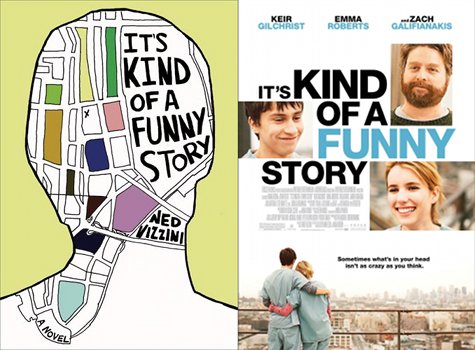


Its about a kid who wants to commit suicide and his journey through the mental health system.

Full disclosure: I work in healthcare, so I've seen firsthand a lot of what the main character experiences in the story. It wasn't as much of a revelation for me as it will be for some people, but because I felt like it portrayed it pretty accurately I think it gave me a greater appreciation for, like, what the patient is going through when you're caring for them.

Also I'm making this post from memory: I've read the book twice and watched the movie twice.


  •  Overall


 Book-


I think the book definitely tells a fuller story of what people go through when they enter the mental health system. It goes into detail about this kid's life before he got institutionalized and explores all the different factors that led to his predicament: even going into detail with the bits that aren't so savory like his sexual frustrations and his drug use. (This is the part of the story where when I read it I realized the author's being real with his audience. It's not the perspective of a teenager telling adults what they want to hear, this is actually how he feels about sex and how he feels about getting high. It's surprisingly nuanced and analytical. He's not moralizing the issue: there are positives and negatives to everything.)

 Movie-


The movie is a lot more streamlined. It starts when the kid asks to be admitted and has these elaborate flashbacks to his life before.

The movie also cuts a lot of the potentially objectionable content. I generally think of this as a good thing because it puts some important issues out there in front of more people. Families could watch it together and use it as a springboard for discussion about mental health issues and concerns. (Though I doubt most kids would get very much out of it without adult guidance.)


  • Perspective/Narrative Style


Book-


The book is written in a first person POV and it has this kind of a candid, informal style. When the main character relates what someone else said, he often prefaces the quotation with a phrase such as 'so-and-so was like' or 'so-and-so was all'. It conveys the sense that like maybe he's just paraphrasing what the other person said from memory and it's not all word-for-word exactly what happened.

Movie-  


I would assume a visual medium would necessitate a more definitive depiction of what characters in a story said or did, but interestingly the movie ends up doing something similar to the book in this regard: when the main character thinks about the past, it's pretty clear a lot of the time he's kind of fantasizing and that what actually happened wasn't as dramatic as he remembers it. Its used to try and inject more humor to the story and sometimes it lands well.

  • Characters


Both Book and Movie-


At one point in the book, the main character is described as having a flat affect, which if you're not familiar with the term it basically just means that he doesn't project a lot of emotion in his face or voice. The actor for that character in the movie really nailed that aspect of his character with limited facial expressions and a deliberate, dry style of line delivery.

What the movie doesn't portray as well is the character's internal monologue. Some of this is conveyed as like the main character talking to the audience, but there's also this really interesting thing where the main character has an imaginary drill Sargent voice in his head who he has conversations with. It adds a lot of color to the narrative, and establishes the main character's metal mindset as it's own kind of domain with it's own rules and processes.

Understandibly, this would be difficult to establish in a visual medium, and the movie doesn't even try. Unfortunately though the absence of this dynamic, coupled with a slow line delivery by the actor, makes it seem like the character is slow to process things (which is definitely not true of the book version of the character). In the book it's rather it's more of the opposite: like he's thinking to fast and can't express it because 'It's all too much' and he gets overwhelmed. 

For example, when someone asks him about his hobbies:


'I work, Monica, and I think about work, and I freak out about work, and I think about how much I think about work, and I freak out about how much I think about how much I think about work, and I think about how freaked out I get about how much I think about how much I think about work. Does that count as a hobby?'


^^What an egregious bit of word vomit, right?! And he doesn't SAY any of it! It's all just what he's thinking in is head, wishing he could've said in that moment.


Aside from the main character, there are a wide array of colorful side characters from all walks of life. I think they're depicted delightfully in both adaptions. In the film some of these people are combined into a single character: the most obvious is the one played by Zach Galifianakis. I kind of liked this, because it gave more interest to the character and you're low-key following him, hoping he can sort his shit out and be involved in his daughter's life.

The downgrade with the film is that you get to know fewer of them. One character I felt was really short-changed was Muqtada. When he finally gets out of bed in the book you feel what an achievement it is for him and you're just so happy for him, in the film it just doesn't have the same affect.

(Also in the book Dr Minerva is the main character's regular therapist. She's not, strictly speaking, employed by the hospital. He has to wait for her to make rounds.)

But the one character change I found most irritating was Noelle:


(LIKE WTF IS THAT!? THAT'S NOT A SCAR THAT'S SOME POORLY APPLIED MAKEUP!!)

It's a total injustice to her character. I could get not wanting to glamorize self-harm, but IS THAT NOT WHAT YOU'RE DOING WHEN YOU MAKE SCARS LOOK AS PRETTY AS THIS??!!!

Instead of presenting her journey as this thing like: 'If you're open about your struggles you can help other people though theirs and form genuine connections regardless of what you look like' 

It becomes: 'Well you're not really that ugly. People can almost forget you actually have struggles at all.'

And that's friggin insulting! 


Conclusion: 


I recommend the book if you're a teenager or an adult. I recommend the movie if you're a family with younger kids who you feel comfortable introducing these types of issues to. I can't promise you a great time with either of these options, but I do think it will give you some food for thought.

Monday, August 26, 2019

The Twilight Sparkle Debarcle

So the My Little Pony: Friendship is Magic series will be ending this next month and I'm growing nostalgic because I have a lot of happy memories watching it with my niece and nephew and exploring the vast content by the fandom community online.

The series itself is far from perfect. It definitely has its fair share of flaws in pacing, character development, and worldbuilding. For one thing, it's pretty really clear that the series was not supposed to last as long as it did: an audience of young girls were meant to watch Twilight Sparkle and her friends grow up and embrace their virtues as women...and then move on with their lives, hopefully taking inspiration from the lessons they learned along with these characters.

But because the series became more popular with an older audience, something had to change. The production company could wrap up the story-line and cancel the series, or they could continue it but cater the series to an older audience demographic.

And, well, they ended up kinda choosing both...

If you're watching the show for Twilight's character arc (which I think most people are at the start) it is perfectly acceptable to stop watching the series after season 3. Her development is a bit rushed towards the end of S3 (because the build up to the finale is only 14 episodes rather than the regular 20+ in seasons 1 & 2) but thematically it's solid and it works.

But because of how long the series ended up being, it feels like she peaks at the very beginning of her character arc. And rather than having her ascension happen as an accumulation of everything she's learned and experienced so far, it ends up feeling unearned.

You're left wondering: "1) Why did this happen now? 2) Does she's really have the life experience and knowledge to impart all this insight she's giving to other characters when she's only ever really dealt with her own little clique of friends?"

(The answer is: 1) It happened "now" because the writers thought they were going to have to cancel the series and 2) No...no she doesn't...

She hasn't yet learned from her past mistakes and failures...


 She hasn't grown a backbone and stood up to authority figures in defense of her values...


She's never dealt with people like the narcissistic personality disorder pony....


The depressed emo pony...


The antisocial personality disorder pony...


And she's never made friends with people who are HARD to be friends with...


Why not have her do all this and THEN make her the "princess of friendship"?
 

 For what it's worth, even though I do see Twilight's premature ascension to royalty as a bad thing that negatively impacts the coherence of the story, I do appreciate that they included these plot points at all. She does get the XP, its just unfortunate that it happens after the story has kind of moved past her as the main focus of the narrative.


End note:

(When I first watched season 5, I thought it would have been kind of cool to introduce "Princess Twilight Sparkle" as a kind of emergency measure against the Tirek invasion. I could just see Celestia going: "Look Twilight, I wasn't gonna tell you for the next couple of years but this is an emergency. I've been grooming you up to take my job, and I need you to step up to the plate right now!" This would have been fantastic because the fact that her status is un-earned is. the. exact. point! She needs to "bring her A game" to prove herself and save everyone...That would have made her boss fight with Tirek even more magnificently epic!) 


Saturday, August 24, 2019

Grief Rambling

There really isn't a point or structure to this post. It's really just to serve as an update so I hopefully start posting consistently again.

It's coming up on two years since I had my Year of Epic Fantasy Reading in 2017. Looking back on that time period on goodreads and how ravenous of a reader I was back then is a bit painful because  I don't get the same amount of pleasure from reading that I used to. It's possible that my reading enthusiasm was starting to fizzle out even before then, but what really discharged my reading passion was the death of my Grandma Peggy. She really encouraged my love of reading, and I think in her declining years I would often use reading as an emotional surrogate because it was one of the things we both really enjoyed and liked to talk about together. (We lived in the same house for quite a while (During my gothic reading challenge), but after she suffered a stroke she lost her color vision and a bit of her hearing, she also became more and more suspicious and forgetful over time. I had tried to listen to audiobooks with her, but she wasn't interested. So I ended up up in my room either reading public domain books or listening to them on Librivox.)

 I think I was in denial, at first, at how bad my grieving was going to be. I thought I could kind of commemorate her life by reading some of the books she enjoyed. The day after she died I went to Barnes and Nobel and saw the newest (and, as it turned out, the last) book in one of G.P's favorite book series: the Amelia Peabody series by Elizabeth Peters. The book was titled The Painted Queen.

I didn't read the back cover, I just bought it and left to Golden Corral to eat my feelings. Only later on did it hit me that this was the LAST book series that she loved, and she would never get to read it. That it would be the last book in the series ever (because the author had died seven years before its publication) and this book had to be co written by another author. And finally that the novel completely lacked any of the charm, wit, or originality that characterized the writing style of the only other book I'd read in the series (Book #1: Crocodile in the Sandbank). Sure it was kind of interesting to see Amelia as a more mature character and have little hints of all the things that happened to her over the course of her life (she had a kid, he's grown up now, her husband still adores her, and she has a mysterious arch rival with whom she shares a mutual, begrudging respect).

But, like, in terms of literary quality that book was complete fucking trash. They have this running joke that the antagonists who are out to kill her are these brothers who are all named after literary traitors (the only one I remember is Judas but one of them might have been named Moriarty or Beelzebub for all I care), and they each die attempting to kill Amelia. It's horribly repetitive and asinine, I did not enjoy it very much at all and I couldn't bring myself to read more than a few pages at a time. After a year, I gave up on it entirely and I am tempted to have a book burning ceremony I hate this book so much.

I also tried to finish Robert Jordan's The Wheel of Time series, which I'd considered my magnum opus for the Year of Epic Fantasy 2017, but it was the time I was starting book number 12. Similar to the Amelia Peabody series, this book was also a book completed by another author after the original author's death. In normal circumstances I think I would have found the new writer's style very bland and unimaginative in comparison to the almost melodic and swell-and-flow style of Mr Jordan, but in the emotional state I was in at the time it felt like I lost a friend.

And then The Last Jedi came out...

(And honestly, like, it's just a bad movie, I recognize it shouldn't be so terribly offensive. But I was at a bad place emotionally, and Rian Johnson mocking my investment in a fantasy series felt like salt in a wound.)

It didn't help that, like, my sister's seemed to turn off emotionally whenever I started talking about how I was feeling. This hurt particularly because I thought, "I've always tried to be interested in how they are feeling and the things they are interested."  It really opened my eyes to how much of my relationships were one-way affairs.

I was also really disappointed (though perhaps I shouldn't have been so surprised) in my Dad, to me he seemed entirely too glad that his mom was dead and wouldn't shut up about what a "beautiful" death she had. I was exactly the thing I didn't need to hear at the time and actually I was really pretty sure he was just glad he didn't have the obligation of taking care of her anymore, because that was something he really seemed to resent. I remember going over to visit right after my Grandma Peggy's brother had died, she was in tears and I was able to talk with her about it for a little bit but when my Dad showed up it he was very dismissive: 'Yeah, well these things happen, shut up and take your meds, Mom.'

Roughly speaking, the world became a stranger to me in October 2017 and I'm still not fully acquainted with the new world. I don't talk to my sisters very much anymore, and I definitely won't open up with my Dad any time soon.

I ended up doing a bit of soul searching and re-evaluating my life and all the things I'd invested in emotionally. I spent time with my Dad's older sister (who I'd probably only met once in my life before this time). She wasn't as invested in her mother's death either because she hadn't been very close with her in many years, but she was emotionally available for me and I will never be able to thank her enough for that.

Because I wasn't enjoying reading much I started cultivating an interest in film and film criticism. Aside from the massive Star Wars film criticism/rant playlist I've compiled on youtube, I find I really enjoy a lot of the Studio Ghibli films that I've seen. I also re-watched/finished the first five seasons of My Little Pony: Friendship is Magic. Both these franchises are ones that I'd initially been drawn to because of their fantasy elements (MLP particularly seems to have some really intriguing  worldbuilding elements in a Greek Mythology-inspired setting but I find I enjoy watching it more as a slice of life/adventure series).

The next year (2018) I made it a point to spend time with my mom after she had surgery and we watched a lot of really cheesy hallmark movies and cheesy christian-motivational type movies. This year (2019) I've been trying to spend a lot of time with my Grandma Vi. She came to live in the same house where G.P. used to live. I have mixed feelings about this because I know this is not the ideal situation for her and I see a lot of patterns repeating themselves. But I do consider it my part to do what I can to enrich her life. She is certainly a lot more receptive conversationally than G.P. had been in the years prior to her death.

Eventually I did start reading again, but it's kind of a "whenever I happen to feel like it" kind of thing, and not consistently the way I used to.

My hope for the future right now is to travel more in the coming years and get a dog. I also want to do start a Horrid Novels Read-Along this October, but we'll see how that goes.

Wednesday, September 12, 2018

My PALS 2018


This post is basically gonna by my notes after reading the pediatric advanced life support, because I'm going in for the update tomorrow and I'm really nervous. Even though I don't really think I'll fail it or anything, it's not material I review a lot. So I've been going over it casually over the past two weeks and I did the little test on line I'm supposed to do. And I'm realizing what a crapload of information it covers, and definitely has me on my toes.

Comparatively, I'd say, Adult cardiac life support and neonatal resuscitation are a bit more straightforward in strategy: you kind of just follow the flow sheet and it tells you exactly what to do. There's a lot more to consider in the pediatric population. For one thing there's the age and size variations: some kids will need to be treated more like neonates, and others will need to be treated more like adults.

There are also medical problems that are a lot more common in the pediatric population than in other populations. For instance: if you find an unresponsive kid out of the blue, you operate under the assumption that what's causing the kid to be unresponsive is respiratory in nature. This is the total opposite of what you do in an adult cardiac arrest, because most kids don't suffer from heart disease. So unless you know the kid has some sort of congenital cardiac condition, or is being hospitalized for sepsis or something, you begin with respiration and you can call out for help but you don't want to leave the patient's side until you've done 5 cycles of CPR. If it hasn't been too long since the collapse, and the problem is respiratory in origin, ventilation support may even be sufficient, so we wanna try that first.

They also go into a lot more detail about specific respiratory problems, and the different types of shock, and none of the medications are, like, a standard dose...they're all based on the patient's weight. So you have to calculate pretty much every dose before you give it.

It's a LOT to remember, and it's so friggin deceptive because the PALS book is, like, the smallest of the AHA books that I've read.

Anyway...I'm just gonna go over my notes one more time. Please forgive the typos and misspellings, but if I'm wrong about instructions or dosages you should comment and let me know.

PALS BLS

CPR with AED and 1 or 2 rescuers:

1) Ensure scene safety
2) check for response, send someone to call 911/get AED
3a) for sudden witnessed collapse and single rescuer: call 911 and get AED
3b) for unwittnessed collapse and single rescuer: activate after performing 5 cycles of CPR
4) Open airway (head-tilt-chin-lift or jaw thrust if suspected neck injury), and check breathing for less than 10 seconds
5) Give 2 breaths that cause the chest to rise and last over 1 second each.
6) check pulse for less than 10 seconds Brachial in infants carotid in kids.
7a) if pulse felt provide rescue breaths at 1 breath Q3 seconds (unless for some reason the patient has an advanced airway, then you'll wanna give them at 10-12 times per minute, which ends up being about once every 6 seconds)
7b) if pulse not felt, begin compressions at a rate of 100-120 per minute, compress to a deapth of 1/3-1/2 and allow to recoil. If there is one rescuer 30 compressions: 2 breaths, use two finger technique for infants or 1-2 hands for older kids.
If there are two rescuers 15 compressions: 2 breaths, use hands encircling technique for infants or 1-2 hands for older kids.
8) If not already done after five cycles/single rescuer: call 911/get AED
9a) If patient is <1 acls="" continue="" cpr="" move="" old="" or="" over="" p="" responders="" starts="" take="" to="" until="" victim="" year="">9b) if patient >1 year old use AED /defibrillator after 5 cycles.
10) Check rhythm if patient > 1 year old.
11) if Rhythm is shockable: give 1 shock and resume CPR x 5 cycles
12) if rhythm is not shockable: resume CPR x5 cycles and recheck rhythm until ACLS providers take over or victim starts to move.


ACLS/PALS providers will need to perform several assessments very quickly:


1) General Assessment:


 Visual and auditory, taking in patient's appearance and work of breathing as well as how well blood circulation seems to be working. This one is very quick and probably the most simple.

2) Primary assessment:


 A rapid hands on ABCDE, cardiopulmonary and neurologial function assessment
A=airway patency.
Positioning, suctioning, airway adjuncts (nasal airway or one of those things to keep the tongue out of the throat) or intubation.

B=breathing
Rate and effort, tidal volume, airway/lung sounds, pulse ox etc.

C=circulation (both cardiac & end organ)
Skin color, temp, HR, Rhythm, pulses (peripheral and central), capilary refill time, BP and pulse pressure, mental status, skin perfusion, renal output.

D=disability
AVPU pediatric response, glascow coma scale, response to voice/touch/pain, pupil response

E=Exposure
remove clothing and examine s/s hypothermia, burns etc. check temp

3) Secondary assessement

identify S/S, allergies, medications, past medical history, last meal, events leading to presentation.  This usually involves asking a lot of questions for the parents if they are present.

4) Tertiary Assessment:


Laboratory tests, radiography tests, and other advance tests that take a lot of time to do so order them stat

Cardiac Arrest Algorithm


If the patient is having cardiac arrest, regardless of whatever else might be going on, you definately will want to treat that fast. I'm not saying if, say, the caradiac arrest is being caused by sepsis that you won't want to treat that too. You'll need a lot of people to kinda do both at the same time. But we're just gonna talk about the cardiac arrest right now.


You'll wanna start with BLS, attach oxygen to the thing giving respiratory support, but once you get the equiptment put on all the electrodes and the defibrilation pads and do a rhythm check.

1) if the rhythim is shockable (VF/VT): give 1 shock manually at 2 J/KG or AED if  patient is > 1 year old. Use a pediatric system for 1-8 years old. then restart CPR x5 cycles and give epinephrine 0.01mg/KG IV/IO or 0.1mg/kg ET and repeat this dose every 3-5 minutes.

 Recheck Rhythim after the five cycles and if it is still shockable give another shock, but this time at 4J/kg, or AED for 1-8 Y/O, and resume CPR x5 cycles.You will probably give epinephrine again about this time.

At the next rhythm check, if it is still shock-able deliver 4J/kg or pediatric AED and also consider amiodarone 5mg/kg IV/IO or lidocane 1mg/kg IV/IO.
Consider magnesium 25-50mg/kg IV/IO max 2grams for torsades de pointes.
After 5 more cycles do another rhythm check and continue defibrillation with the 4J/kg if indicated.


2) if at any point the rhythim is not shockable (asystole/PEA): Resume CPR x5 cycles, give epinephrine 0.01mg/kg IV or IO or 0.1mg/kg ET. Repeat Q3-5 minutes. and Recheck rhythm after the five cycles. If rhythm is now shock-able: start with the 2J/kg dose.

You will also want to consider the Hs and Ts while you're doing all of this (which I did a whole other series of posts about a few years ago)

Bradycardia (with cardiovascular compromise) Algorithm


1 Support ABCs-give O2, attach monitor/defib. and get 12 lead EKG
2a) if compromise resolved, continue to support Airway, Breathing, Circulation and consider expert consultation
2b) if symptoms persistent and HR <60 cpr="" p="" start="">
3) give epinephrine 0.01mg/kg iv or 0.1mg/kg et. if elvated vagale tone or primary AV block is noted give atropine 0.02mg/kg, may repeat to max dose 1mg.


 Tachycardia with pulsses and poor perfusion


1) 12 lead EKG
2a) If narrow QRS (<0 .08="" a="" and="" causes.="" constant="" correlate="" for="" history="" in="" infants="" interval="" is="" normal="" p="" pr="" present="" probable="" r-r="" search="" sec="" sinus="" st="" tacycardia="" treat="" usually="" variable="" waves="" with="">220, and in children it's >180.
2b)  If narrow QRS and probable SVT (correlate history: vague nonsepcific h/o abrupt heart rate changes, P waves present/abnormal, HR not variable) consider vagal manuver. if ineffective establish IV access and give adenosine 0.1mg/kg to a max of 6 mg rapid IVP, may administer a second time with twice the amount of drug dose (max 12mg).
If ineffective, perform syncronized cardioversion at 0.5J/kg. if not effective may increase to 2J/kg please sedate pateint if possible but dont delay cardioversion.

Obtain expert consultation and administer amiodarine 5mg/kg IV over 20-60 minutes or procainamide 15mg/kg over 30-60 minute BUT DO NOT ADMINISTER THEM TOGETHER....

Respiratory Emergencies


There's no real algorithm for this one. Differental treatment is based on how bad the symptoms are and whether you determine its an upper airway, lower airway, lung tissue, or disordered control of breathing problem.

People with breathing problems are generally anxious in the early stages and lethargic in the later stages, tachycardia is an early symptom but it progresses to bradycardia as breathing function deteriorates. Infants and young kids may often have a distinctive head-bobbing or seasawing breathing pattern in the abdomen.

Upper airway problems often present with inspiratory stridor, a seal like cough, and hoarse breathing.
(ex: croup- give nebulized epinephrine and corticosteroids, anaphylaxis-give IM epinephrine, albuterol 0.5mg/kg/hr with a max of 20mg/hr, antihstamine benadryl 1-2 mg/kg iv Q4-6 hours, Corticosteroid Dexamethasone 0.6mg/g IM/IV max 16.

Lower airway problems often present with expiratory wheezing, prolnged expiratory phase breathing (ex: aspiration-position to comfort and specialty consult. Bronchoiolitis-nasal suction and brinchodilator trial. Asthma-albuterol with or without ipratropium, corticosteroid, SQ epinephrine, mag sulfate, terbuttaline.)

Lung tissue/parnecymal problems often present with Grunting, crackles, and diminished breath sounds (ex; pneumonia/pneumonitis-albuterol 0.5mg/kg/hr with a max of 20 hr. and start ABT. Pulmonary edema-ventilatory support with PEEP vasoactive support, diuretic lasix 1mg/kg max 20)

Disordered control of breathing presents with normal lung sounds but a disordered breathing pattern.
 (ex: incresed inacranial pressure, avoid hypozimia, hypercarbia, hyperthermia...which makes it really hard to do things like provide ventilatory support...basically this person needs an ET tube and if possible and ICP line. Poison-antidote/poison control. neuromuscular disease-ventilation support.

 PALS Septic Shock Algorithm

 1) Recognize ALOC and decreased perfusion-give o2 and support venntlation, start IV, begin advanced life support if needed.
2) consider VBG and ABG, lactate, glucose, ionized calcium, BC, CBC.
3) Within the first our Bolus 20ml/kg NS or LR (probably more than 1 bolus will be needed, if the patient has an underlying cardiac problem or if cardiogenic shock is suspected give 5-10ml/kg), correct hypoglycemia with D25W 2-4ml/kg or D10W 5-10mlg/kg (0.5-1g/kg) DO NOT GIVE GLUCOSE FLUID TO CORRECT HYPOVOLEMIA, correct hypocalcemia 20ml/kg slow IVP calcium chloride 10%, give first dose ABT and consider vasopressors and hydrocortisone

4) monitor response:

 a) if symptoms resolve-consider transfer to IC
 b) if no change or worstening begin vasoactive therapy, iv/arterial access
  •   if BP nrmal give dopamine 2-20ug/kg/min
  • if hypotensive/warm shock-give norepinephrine 0.1-1ug/kg/min
  • if hypotensive/cold shock-give epinephrine 0.1-1ug/kg/min
Cold shock refers to vasoconstriction peripherally, warm shock refers to dilation of the blood vessels.

You will want to evaluate SCVo2:

if it is > 70% with low BP/Warm shock -NS at 20ml/kg, norepinephrine with or without vasopressin

if SCVo2 is < 70 with normal PB but poor perfusion: PRBC to HGB>10g/dl, NS or LR at 20ml/kg optimize arterial O2, consider milrione 50-75ug/kg over 10-60minutes, consider nitroprusside 1-8 ug/kg/min, consider dobutamine 2-20ug/kg/min,

if SCVo2 <70 and="" blood="" cold="" hgb="" low="" perfusion="" poor="" prbc="" pressure="" shock:="" to="" until="" with="">10g/dl, optimize SPO2, NS or LR at 20ml/kg, epinephrine 0.1-1ug/kg, or dobutamine and norepinpeprhine

Consider hydrocortisone approx 2mg/kg max 100mg if adrenal insufficiency is suspected (due to all the stimulants we've been giving)

Monday, April 16, 2018

Saidin and Saidar: An Overview of Gender Division in Robert Jordan's "The Eye of The World"

One of the most interesting aspects of Robert Jordan's "The Wheel of Time" is his depiction of the balance of power between the sexes, both in interpersonal relationships and society at large. I don't think I've ever read a story that handles this topic quite the way this series does; and I really appreciate the the level of thought and consideration that must have gone into it. It really made me consider femininity and masculinity as concepts in a way I hadn't before.

I kind of have the feeling that a lot of people today might take issue with this series because the story itself, even down to the worldbuilding, does convey a very strong distinction between a masculine identity and a feminine identity. But I think it's something you could learn from even if you feel like it doesn't capture the entire spectrum of gender identity.

The story starts out in this small town called Emond's Field, which is run by two governing branches: The Town Council (comprised of men) and The Women's Circle (made up of...ya know...). Even though it seems a bit like these two groups kinda bicker and don't always see eye to eye, you get the sense that they're keeping each other accountable. Like there is tension, but it's the kind of tension that is supposed to be there in a balanced society so that everyone is represented fairly.

Anyway...
In the story, the people of Emond's Field are about to celebrate their annual spring festival: Bel Tine (Which is Medieval Fun-Time Land's version of the Celtic festival Beltine...May Day...which commemorates the mystical union between the male and female aspects of divinity. They never go into this in the story, but it stuck out to me as pretty significant symbolism...) 

So far, everything seems fairly balanced between men and women...

Then Moraine comes into town:


(With her beefy bodyguard/personal assistant, Lan, in tow.)

Moraine is a member of an order of very powerful female magicians who are generally distrusted by rural folk due to their penchant for enchanting men and taking them as their Warders (personal assistant/bodyguards). 

Men are apparently defenseless toward these magic users, because 1) most men a can't use magic and 2) Men who can use magic are "tainted" or corrupted in some horrible way, causing them to be systematically hunted down and imprisoned by those in power. Eventually they have their power (along with their will to live) severed from them and most of them end up committing suicide. 


(Interestingly, this is not presented as oppression
 but as an unfortunate necessity.) 

So slowly we start to gather that life out there in the wide world is not nearly as balanced as it would at first appear to be. Generally speaking, the balance of power in the world at large is slanted to favor women. (Now, this is not unanimously the case... The world is a pretty big place and every country and culture kind of deals with the situation a bit differently, but in general this holds true.) The country Emond's Field is nominally a part of is lead by a matriarchy: Women are Queens, men are their consorts. This is the way the world works, and it's the way the world is meant to work, and the main characters, 3/5 of whom are male, do not question any of this.

Not surprisingly, the Bel Tine celebrations are disrupted and order within the community devolves into chaos when they are attacked by the NOT ORCS. And it emerges that the male 3/5ths of the POV characters are magic-destiny boys who are fated to change the world in some significant way. And so the Emond's Field boys (Rand, Mat and Perrin) are ushered off on to their adventure.

I think it's interesting that the female Emond's Fielders are actually the ones who are who are given agency in this scenario: Nynaeve and Egwene (the female 2/5ths of the MC's) go along on the adventure of their own free will (out of a moral imperative and as an opportunist, respectively), while the Male MC's are forced into it.

I don't think it would be quite fair to think of Rand, Mat, and Perrin as passive figures, but they are being manipulated by forces outside of their understanding and control. This, compounded by their "Special" status, kinda makes them seem a bit like an inverted princess archetype with Nynaeve and Egwene as the traditional adventurers. 

Towards the end of their adventure in this book, Rand meets a NOT ENT called "The Green Man". who's this kind of male nature-guardian, holding the last bit of uncorrupted Saidin (male-magic), which Rand gets to experience before it is extinguished. 

Overall I think it's a really clever inversion of gender inequality as we normally think of it. You get to see this kind of benevolent sexism, and the rationalization for it, as well as an inkling of what a genuinely feminist culture might look like in Andor. The exploration continues in the subsequent books where we see a fuller exploration of female hierarchy, female leadership, as well as the power of a well-balanced relationship.

Wednesday, January 31, 2018

Year of Epic Fantasy Reading 2017: Day 31 (The Children of Hurin)

Title: The Children of Hurin
Author: John Ronald Reuel Tolkien
Themes: Humanity
Quotes: "Others of the House of Hador bear themselves otherwise, and Tuor among them. For they use courtesy, and they listen to good counsel, holding the Lords of the West in awe. But you, it seems, will take council with your own wisdom..."
Reading/Listening Time: 7 hours, 51 minutes


Review:

This one is a little bit cheating, because I had read this one back in 2009, but I decided to listen to it in 2017 because I found out Christopher Lee performed for the audiobook.

For this review I want to focus on the particular things that stood out to me on this second reading. If you're only familiar with Tolkien's work through "The Lord of The Rings", or even "The Hobbit", this book may take you by surprise. It's written in a similar narrative style to LOTR, but it's a tragedy rather than a heroic tale. (If LOTR is about persevering through adversity with hope, this book is about persevering through adversity when there is no hope.)

We as the readers watch everything that could possibly go wrong, go wrong for our protagonists. Yes, it is a bit of a downer, and I can understand why it might not resonate with most people the way Mr Tolkien's more traditionally heroic offerings do.

However, for me this story is extraordinarily meaningful in the way it explores human nature: thematically, it's willing to go places "The Lord of the Rings" isn't willing to go and because of that it can say things that LOTR couldn't.

(I also think it adds a lot to the whole mythology and background of Middle Earth as a fantasy setting without reading like a D&D guidebook.)

What stood out to me most on my second reading was how the main character's journey was kind of an affirmation of the human identity. In the story, Turin and Nienor have a choice: They can stay with the elves and be safe, or they can venture out into the world and face life on their own terms.

If you're a fan of Tolkien, this story shows us a significant turning point in Middle Earth history. Humans are still a pretty new race in the world and a lot of them like to see themselves as a shorter-lived, weaker versions of what Elves are. Through the course of the story we ultimately see the two kindred races diverge into culturally distinct, separate societies with very different interests and outlooks on life.


Just as a WARNING rest of this post is going to have significant PLOT SPOILERS


What kicks it off is this monumental change is this horrific military defeat: There's this big-bad guy, decides to go to war against an Elvish city (yes, elves had cities back then). The Elves call for help, and their human neighbors take up the call. One of these guys is named Hurin, he's a chief and he leaves behind his pregnant wife and two children. They're the focus of the story because, of course, Hurin's army (along with everyone else...elf and human...who goes to fight) gets decimated.

Oddly enough, Hurin is captured alive. Even though he won, the big-bad guy is so epically pissed at Hurin for helping the elves and making his job harder, that he decides to keep him alive and perform a uniquely cruel form of psychological torture:

The big-bad guy is going to curse Hurin's family, and have Hurin watch how the rest of their lives play out with absolutely no chance of escaping or helping them an any way.

From here the perspective shifts to Hurin's family, but we know Hurin is watching the story unfold alongside us (the reader).

Back at Hurin's village, another chieftain comes into his village and ransacks everything, and abuses his family. Hurin's three-year-old daughter dies of illness, and his son is sent off to live with Elves so the new guy in charge won't kill him. Then the new baby is born, and she looks ridiculously like the father she'll never meet.

Hurin's son is somewhat protected from misfortune while he is with the elves, but presumably Hurin is still watching him being raised by well meaning but emotionally distant elves. Turin does make one elvish friend, but she kind of lives on the fringe of society.

Right away, we notice a big disconnect in the way the Elves and the Humans have handled this loss:


  • The elves suffer a major defeat. The bad guy won, so they decide to stop fighting and live in secret.


  • As a society humans can't really do that, so they have to live under a new regime. 


Hurin's son (Turin) starts to grow up and he starts getting ticked that the elves aren't planning on fighting the big-bad guy who ruined their lives. We start to see how the races different ways of dealing with loss can cause conflict:


  • Turin believes that you should try to make a difference in the world. That your life should ultimately mean something; that he (Turin) should try to make a difference-even if he ultimately fails.


  • The Elves think this is stupid; they'd much rather enjoy immortality than glory.
(^^which is interesting to me because clearly if Turin stayed with them he'd have neither of those things)

Ultimately these two approaches to life aren't compatible. Even after he's come to respect their point of view a bit, he decides that he can't follow their mores. Even after he leaves and whole bunch of horrible stuff starts happening to him, he isn't really tempted to go back.

On my first reading, I kinda thought the point of the story was that Turin should have tried to live more like an elf. (This really fits because Professor Tolkien was really Pro-Elf, like, in LOTR he'll just stop the whole narrative to fanboy about how awesome they are...). There's no doubt in this story that if Turin had stayed safely in obscurity he would have avoided a lot of the horrible stuff that happened to him later on.

On my second reading, I think I have a different impression of what this story is trying to do. Tolkien may be a Elf-fanboy, but this story is  trying to demonstrate more than it's trying preach. It's not about elves, it's about how humans are NOT...and shouldn't be...like elves:

Turin has not one but TWO female elves who fall in love with him, but he can't reciprocate those feelings romantically because he's looking for something that they don't have. At one point there's this evil dragon who manipulates Turin into choose between helping his elvish friends or his human family, it's presented as a gut-wrenching choice but ultimately he chooses his family. Both of these choices are ultimately used against Turin as part of the curse, but on this reading I can't think of them as inherently wrong decisions in context of the larger narrative in Middle Earth.

 For both Turin and his sister Nienor, the elvish sanctuary is a nice place to visit but a horrible place to call home. A static paradise is not a paradise for humans because humans are made for change: to fight or fail, to challenge and redefine the perimeters of their world. 

So whether or not living life their own terms was "worth it" for Turin and Nienor personally, their attempts to do so become cemented into the collective human (and hobbit) identity.

In later ages of Tolkien Legendarium, we see the elves continue to disengage and withdraw into their comfort zone. (Which I guess is perfectly appropriate when you'll live forever and you don't reproduce very fast.) We also see humans/hobbits become more proactive force in the world. That's the real legacy of Turin and Nienor...

Rating: 4/5 Stars


End notes:

Thank you to anyone who's been reading these and sharing my journey. Again, it's kind of a solitary exercise (as much as I try to make it more social on goodreads).

I just carry these things inside me, and it's nice to write these little reviews/commentaries like going to visit a friend (and also...like saying goodbye a bit).

Since my Grandma Peggy died, I've had a really hard time with reading. I was ravenous, and now it's kinda painful because it was G.P who really got me into and encouraged my love of reading. (even though, strangely, we didn't read many of the same things! She loved romances and mysteries! I'm more into classics.)


  • My goal in 2018 is 10 bilingual books.


  • A few other fantasy books that I would definitely recommend:


-Sabriel by Garth Nix
-Norse Mythology by Neil Gaiman
-Jim Henson's Labyrinth by A.C.H Smith
and 
-The Last Unicorn by Peter S. Beagle


  • Also if you have a favorite book in the fantasy genre I'd love to hear about it, feel free to leave a comment :)


Saturday, January 27, 2018

Year of Epic Fantasy Reading: Day 30 (Fireblood)

Title: Fireblood
Author: Jeff Wheeler
Themes: Trust
Quotes: "Strange how people yearn to become holy only after years of depravity.” She smiled knowingly. “Give me chastity and continence, but not yet.”
Reading/Listening Time: 12 hours, 25 minutes


Review:

This was another book that I felt was pretty exciting.  It starts out with this team of wizards from Mirrowen's CDC and they're on a mission to stop this horrible plague. And they end up getting completely massacred. Only two people survive.

And then it skips to, like, 20 years later. It ends up being like you're kind of following two stories: the present timeline, and what's happened in the past 20 years to the survivors of that "CDC" team.

It's interesting because it sets up this sense of uncertainty and you're not really sure who should trust who. The main character is inclined to be obliging, and as a reader you're kinda wondering whether or not he should be like that... Like, "Maybe he's being too naive...but also there could be a really good reason why he can't know certain things yet???"

It ends up being a bit of both, I particularly loved the twist with SPOILER ALERT the sister who acted all nice, but ended up trying to use him for stuff END SPOILER

My favorite character was Paedrin. He's, like, this monk-knight helping the main character. His perspective on the world was a pretty neat contrast to the other characters, plus I thought he was pretty funny.


Rating: 4/5 Stars.


Note:

I was really excited, after I finished this one, and started it's sequel right away.

I didn't finish it, and I thought it was a lot less exciting because it introduced this really boring new character who I didn't care about. If this weren't a sequel, I could understand playing up the mystery some more, but when you're hitting literally every. single. mystery. that we've already figured out from the first book, like you expect us to be surprised all over again, I call bull.