Friday, October 9, 2015

The Island of Dr. Moreau

Story 6/31

The Island of Dr Moreau

Herbert George Wells
Listening Time: 4 hours 39 minutes

Link: https://librivox.org/the-island-of-dr-moreau-by-hg-wells/

Themes: Scientific Ethics, Dogma


Quote: “Whatever is more than animal within us must find its solace and its hope. I hope, or I

could not live.”

I feel really blessed to live in the current era! I mean, I know we deal with a lot of issues.We're still trying to figure out stuff like...

 "Is abortion acceptable?" and

"Should we really be using embryos as a source of stem cells for research?" 

I can hardly imagine what it must have been like for the average person during the time of Darwin and Huxley, when many of the scientific principles we now live by were relatively new. I'm certain it must have dramatically changed the way a lot of people saw themselves, and how they saw the future of the world around them.

How do you view yourself within a biologic framework? How do your see yourself as part of a continuum of the "natural" world? What makes me a person?

These are perspectives on life that I typically take for granite, because I grew up with a degree of familiarity with them. But then I started reading works like this one: it's the dawn of the modern biological-scientific era. People aren't as scared of shady aristocrats, creepy castles and ghosts as they used to be. Now people are scared of science; or more particularly, the things we might discover through science...about who we are and why we do the things we do..

Are we not men?


This is the type of story that, if I heard someone explain the plot to me, I'd probably think it was a little cheesy. It's fortunate, then, that I was not familiar with this book before I read it. There are aspects of it that are very chilling and thought provoking, particularly in the last three chapters, but (from the modern perspective particularly) you do have to suspend disbelief for a bit.

Also helped me add my own color to the story. I had my own vision for what the various characters looked like, and when I finally saw some screenshots for the movie adaptions...


"That is NOT what they LOOK LIKE!!"


Wednesday, October 7, 2015

The War of the Worlds

Story 5/31

The War of the Worlds

by H.G. Wells

Exploring this story was a bit of a different experience for me this year. It's one of the times I explored the gothic genre's influence in science fiction, and also because I read it from a book instead of just listening to it on librivox.


(an actual book...that I had to hold, with words...that I had to look at...wow!)

In addition to reading it over the summer, I just finished listening to the audio book on librovox. And, I have to say, hearing it a second time has altered my opinion of the main character a bit.

Listening Time: 6 hours 35 minutes

Link: https://librivox.org/war-of-the-worlds-solo-by-h-g-wells/

Quote: “This isn't a war, [...] it never was a war, any more than there's war between man and ants.” 

Theme: Imperialism

There are moments of genuine atmospheric fear in this story; the times when the narrator is up-close and personal with the Martians are particularly memorable. However, much of the story is told in past tense:  supposedly everyone in his audience is already familiar with "The Great Disillusionment" and he's just telling us about his particular experience. 

In that sense, it this story evokes the type of fear Michael Crition books go for. These depictions of human vulnerability and hubris also provide a scientific-type for the predestination and prophecy of the genre's gothic predecessors. 


In the radio dramatic adaption, much of the action is happening in "real time". The sensationalism and panic of the event is realized almost immediately. I think this is a compelling way to tell the story.

The book, however, the realization of the onset of the horror is gradual. No one knows what to think of the Martians at first because they're seem very slow, and not too intimidating. Information about the landing travels slowly through the countryside (because they don't have radio ;). It takes time for the natives of Britain to gauge the intentions of the colonizing Martians. This allows for a bit more through examination of human nature and how different people respond to fear..


For much of the story, the Narrator is in 'survival-mode'. He's extremely goal oriented; he's got to get to the town where his wife is and that's the one thing that keeps him going through the tumult. 

Even with the benefit of retrospect, he doesn't have a lot of insight into his own state of mind. 


"It is a curious thing that I felt angry with my wife; I cannot account for it."

Most of the time he communicates events in a very factual way, without excessive descriptions of the fear and terror he was obviously feeling. It also leads to him being very callous and cold towards other people. I find it ironic that he can point out all the follies of every person he interacted with, but not towards himself.

How this personal tenancy contributed to the escalating tension in in the story became even more evident when I listened to audiobook today:

(From chapter 13)


The Curate: "What does it mean?" What do these things mean? [...]Why are these things permitted? What sins have we done? The morning service was over, I was walking through the roads to clear my brain for the afternoon, and then--fire, earthquake, death! As if it were Sodom and Gomorrah! All our work undone, all the work---- What are these Martians?"


This dude is clearly in a state of complete panic. The narrator is dismissive...

Narrator: "Are we far from Sunbury?"

...and none too sympathetic:


The Narrator: "Be a man!"

I'm not saying he should have gone all touchy-feely with this guy, but at this point in the story there isn't an imminent threat surrounding these two people. There was time for the narrator to engage this man, assess his psychological state, see if he can be reasoned with, possibly mitigate a lot of the tension that was going on in his mind, and plan...

For the time when there IS an eminent threat...


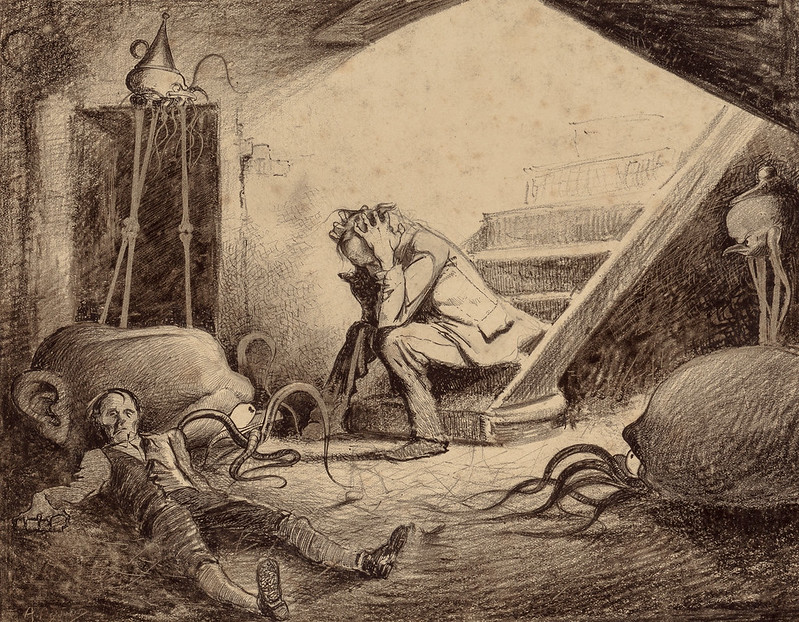
(Martians are vampires, apparently. Who knew?)

I agree with the narrator when he says that 'this was not a crime' on his part. Because crime is "to forsee and do" but I'm disappointed that he can't recognize his own human vulnerability.

Because in the end, this story is not about facing aliens, it's about people who behave in just the same way as we do. And the fear that someday, someone will do unto us as we have done unto others.


Monday, October 5, 2015

The Masque of the Red Death

Story 4/31

The Masque of the Red Death

By Edgar Allan Poe

(It's number ten, about half way down)

Listening Time: 13 minutes

Quote: "Even with the utterly lost, to whom life and death are equally jests, there are matters of which no jest can be made." 

Themes: Public Health, Mortality

I think that even without any social or historic points of reference, this story would still be chilling. However it particularly resonated with me because my country had just gone through something that was eerily analogous to some of the events that happen in this story. 

You may have heard of this little guy:


"No pestilence had ever been so fatal, or so hideous."

If you remember the "Ebola Scare" in the United States, you already have a general idea of what Mr Poe is going for in this story.

Told within the framework of a devastating, infectious, hemorrhagic fever, it's no shock to me that someone would want to isolate themselves for protection. It's probably the first thing I'd do if Ebola became airborne and started killing everyone in my neighborhood.

But Prince Prospero goes a step further:

“The external world could take care of itself, in the meantime it was folly to grieve or to think.”

He's the type of character you'd watch in a disaster flick: the one who behaves so atrociously that literally the whole time you're waiting for him/her to die some horrible death so you can fistpump and clap.

And Poe delivers.

(Oh, boy does he!)


Mr Allan Poe is another one of those authors who doesn't want you to put his stories within a particular moral context, he just wants you to be afraid. However, I just can't help it...(I promise not all of these advents will be this way):

Whether it's by disease, violence, or age (...or, if you are a jerk like Prospero, a symbolic combination of the three...) 


(Death is the great equalizer of life.)


No matter how rich or poor you are, or if you're from an affluent country or an impoverished country, a confrontation between you and death is inevitable. 

So it's folly to live as if misfortune and death will not affect us. And it is evil to live without consideration of those who are suffering, especially if you have the means to relieve it in any way.


  I thought I was pretty smart, thinking of the similarities between "The Red Death" and Ebola, but it turns out the CDC had already noticed the same thing, like 12 years before.


Saturday, October 3, 2015

The Shadow Over Innsmouth

Story 3/31:

The Shadow Over Innsmouth

by Howard Phillips Lovecraft


"But for all of their monstrousness they were not unfamiliar to me."


Librivox Listening Time: 190 minutes

Listening Link: http://librivox.bookdesign.biz/book/107042

Themes: Racism

Mr Lovecraft objected to Weird, Supernatural Horror, or Cosmic Horror being put into a moral or intellectual framework.

"Atmosphere" He says, "is the all-important thing, for the final criterion of authenticity is not the dovetailing of a plot but the creation of a given sensation. [...] a weird story whose intent is to teach,
produce a social effect, or one in which the horrors are finally explained away by natural means, is not a genuine tale of cosmic fear..." (Source: Supernatural Horror In Literature)

Well, I'm going to do something Mr Lovecraft probably wouldn't like.


(Because putting his stories into a moral and intellectual framework is just too freaking easy!) 

I'm not trying to suggest that Mr Lovecraft does not create that 'authentic' atmosphere of fear he was aiming for. I rather think that, because he was so effective in creating that atmosphere, and because he pretty much only wrote about things that made him afraid, he gave me a sympathy for a group of people who I would normally look at with a degree of skepticism and contempt.

For Mr Lovecraft, the origin of racist ideology isn't a feeling of superiority over other races: It's the fear that the process of assuming a multi-racial identity will take something away from you...either individually or collectively (For Robert Olmstead, it is literally a dehumanizing process).

In some ways, I think that's true.


(Not the 'We'll-Turn-Into-Fish-People' part...just to be clear...)

The cultural-landscape in American is supposed to be dynamic, so dealing with cultural change is enviable as we adopt new customs and old ones become obsolete.

So, when this happens, are we loosing something or are we gaining something? When is cultural change something we should be wary of, and when should it be embraced?


Just for fun: here's a cool video of an octopus stealing a camera!


The Yellow Wallpaper

Story 2/31: The Yellow Wallpaper

by Charlotte Perkins Gilman

"It is the strangest yellow, that wallpaper! It makes me think of all the yellow things I ever saw - not beautiful ones like buttercups, but old foul, bad yellow things.” 

Listening Time: 32 minutes

https://librivox.org/ghost-story-collection-005/ (It's the tenth story on the list, at the very bottom. Ironically it's not a ghost story at all.)

Themes: Mental Health, Advocacy.

There is a really interesting article by the lady who wrote the story here:

 http://classiclit.about.com/od/yellowwallpapergilman/a/Why-I-Wrote-The-Yellow-Wallpaper.htm

There is another story I'll be talking about later that also deals with the "sinister yellow". A color that you'd normally associate with happiness becomes oppressive, irritating and maddening when used in excess.

In the narrator's room, there are many shades of yellow and all of them are UGLY! The wallpaper also has an intriguing design (For some reason I imagine the design to be inspired by Arabic script). The water damage and mold splotches on the wallpaper give the room unique visual effect: the walls...or something behind them...are moving.

"I never saw so much expression in an inanimate thing before, and we all know how much expression they have! I used to lie awake as a child and get more entertainment and terror out of blank walls and plain furniture than most children could find in a toy-store."

Over the course of the story, the narrator spends a lot of time in this room. She goes from being repulsed by the wallpaper to being fixated on it.

The first time I read it the story I thought:


But this year, reading it again, I'm very impressed with how concise the story is and how poignant the symbolism is. 

In a lot of these types of stories once you find out that the character is an unreliable narrator you can kind of be dismissive about the whole thing. Like: "Oh, they were just hallucinating the ghosts..." and "There was never any danger, they're just crazy".

In this story, you can't just write her off in that way. The horror isn't in whether or not she's having hallucinations, or whether or not there really are people stuck in the walls. We already know at the beginning really going on...so does she. 

"[but] what can one do?"

As a reader, you're put in the same position that she is; watching the whole situation spiral out of control and not being able to do anything about it. And that's what (I think) makes it an excellent piece of psychological horror. 


Friday, October 2, 2015

The Horla

Story 1/31: The Horla, or Modern Ghosts

by Henri René Albert Guy de Maupassant


Listening time: 1 Hour 15 minutes

Quote:

“I believed...yes, I believed an invisible being lived under my roof! How weak our head is! And how quickly it is terrified and goes astray as soon as we are struck by a small, incomprehensible fact! Instead of concluding with these simple words “I do not understand because the cause escapes me," we immediately imagine supernatural mysteries and terrible powers.”

Link: http://librivox.bookdesign.biz/book/3073 (in two parts)

Themes: Mesmerism and Insanity.


Monsieur Maupassant re-wrote this story twice. Once as “Letter of a Madman” and afterwards as this version; which reads as a series of journal entries. Presumably the two different versions are about the same person.

In the years following the original publication of this story, Monsieur Maupassant was committed to an institution, where he died. There is a lot of speculation about this story and whither or not it deals with some of the feelings and struggles that the author dealt with on a daily basis.


(As you can imagine, it's pretty dark.)

When I first read the story, I assumed “Horla” was a made up word that didn't have any meaning, but it does. In French it means something like “alien” or “outsider”. The story is also sub-titled “Modern Ghosts”.

The story starts out with the guy at his home in the country feeling completely in his element. He's full of goodwill and appreciative of all he has.

Later on we see him in the city, which is definitely NOT his element. He's of a completely different nature there: very, very cynical and pessimistic and goes on a little rant about how horrible society is and how it will never amount to anything.

It's like watching a soft, fluffy kitty transform into Grumpy Cat.

I like to think that this personality-transformation isn't due to anything “The Horla” did, it's a part of his personality. He's kind of a grumpy man, an individualist, and smart. 

He thinks up these experiments to see if someone, beside himself, is moving moving things around his room at night. He also investigates while he's in the city. He meets a hypnotist and witnesses the powers of subliminal suggestion and concludes that a similarly toxic influence has happened to him. He is even able to trace where his horla came from, and how it ended up in his house.

(It ends up being really innocuous. Reminds me of all those hyperbolic articles on the internet about the dangers of doing perfectly innocent things: “Three Ways You Didn't Know You Were Killing Your Child” and such crap that people buy into. There really isn't any way he could have prevented this situation, which makes him feel even more powerless and oppressed. )

The most chilling part for me is when he actually “catches” the creature. And he does this twice:

Once while he's in a garden smelling loverly roses, as you do, and he sees a rose beside him bend at an unnatural angle and snap. It's as if someone beside him saw him smelling the flowers and decided to try it, too.

Another time he actually sees it; he's in his study he feels it standing right behind his chair. But he plays it cool long enough to get it to stand in front of the mirror in the room. Then he whiplashes around and can't see his reflection!


The guy purports that the horla are clearly trying to take over the world and make us their livestock. It's unclear if his assertions are the supposed to be the horla talking to him or paranoia turning into psychosis. His particular horla is possessive, but not particularly ambitious: the most it wants is for the guy to stay at home with it, to leave out plenty of drink at night, to cuddle up with it while he sleeps and let it suck the life energy from his mouth.


(Is that too much to ask)

The Horla's “world dominion” seems very mundane.

The guy cites a variety of paranormal phenomena in folklore that can be attributable to these invisible aliens: Vampires, ghosts, elves etc.

And at that point it became clear to me: “The Horla” is not an alien and it's not from outer space. 

“Aliens” with mind-control powers that have apparently lived on earth for hundreds and hundreds of years, and are hell-bent on world dominion, wouldn't target an ordinary guy and tell him to stay at home. This cenario only works if "The Horla" have already obtained world dominion...

The Horla is clearly a primordial djinn. 

The saddest part of the story is, while he's dealing with this invisible toxic influence, his inclination is to want to deal with the problem himself. He's not really look around and see if other people around him are going through the same thing; or trying to seek help.

Which is really unfortunate because it's pretty clear that all of his servants had the same phenomena going on in their lives. And instead of teaming up with them to exorcise  their house the guy...

Well...I won't spoil the ending too much here.

Sufficeth to say, he's in the mad house for a reason.


The narrator doesn't have a name (Well he might have one, but he never tells us what it is)

I call him Guy. He looks kind of like this:

Except he's French, not Italian


Thursday, October 1, 2015

Scary Story Autumn Advent Calendar: Day -1

Hello and welcome to my virtual Haunted Mansion:

Please Press Play:


Now Read in your best Ghost Host Voice:

"When hinges creak in doorless chambers


and strange and frightening sounds echo through the halls

whenever candle lights flicker...


and the air is dealthly still...

That is the time when ghosts are present, practicing their terror with ghoulish delight,

***
Welcome, Foolish Mortals...

To The Haunted Mansion

I am your host...Your "Ghost Host"

Kindly step all the way in, please. And make room for everyone...
There's no turning back now!

***

Our tour begins here, in this gallery, where you see paintings of some of our guests as they appeared in their corruptible, mortal state.

***

Your cadaverous pallor betrays an aura of foreboding, almost as though you sense a disquieting metamorphosis. 

Hmm?

And consider this dismaying observation: 

This chamber has no windows, and no doors.

Which offers you this chilling challenge: to find a way out!

Of course...there's always...

My way...


Oh! I didn't mean to frighten you prematurely; the real chills come later.

Now...as they say...look alive! and we'll continue our little tour.

And lets all stay together, please!

***

There are several prominent ghosts who have retired here from creepy old crypts all over the world.


Actually, we have nine-hundred and ninety-nine happy haunts here...
but there's room for a thousand...

Any volunteers?

If you insist on lagging behind, you may not need to volunteer!

***

The carriage that will carry you into the moldering sanctum of the spirit world will accommodate you and one or two loved ones. Kindly watch your step as you board, please.

We spirits haunt our best in gloomy darkness, so remember, no flash pictures, please.

***
DO NOT PULL DOWN ON the safety bar, please. 

I will lower it for you. And heed this warning: the spirits will materialize only if you remain quietly seated at all times. 

***
We find it delightfully unlivable here in this ghostly retreat. Every room has wall-to-wall creeps, and hot and cold running chills. 

Shh...Listen!

All our ghosts have been dying to meet you...

This one can hardly contain himself...

("Let me out! Let me outta here!)


Unfortunately, they all seem to have trouble getting through. 

Perhaps Madam Leota can establish contact. She has  a remarkable head for materializing the disembodied
The Happy Haunts have received your sympathetic vibrations and are beginning to materialize...

They're assembling for a Swinging Wake, and they'll be expecting me.

I'll see you all a little later...
Ah! There you are, and just in time! 
There's a little matter I forgot to mention:

BE-ware of Hitchhiking Ghosts! They have selected you to fill our quota, and they'll haunt you until you return.

Now I will raise the safety bar..and a ghost will follow you home!

HAHAHAHAHAHHHAA!


Bonus: What the Ghost Host could have sounded like:


(Also, Originally a One-Eyed cat was going to feature prominently in the ride, apparently.)